
Finding a potential supplier online can feel like a major win, but that initial excitement can quickly turn to uncertainty. How do you know if the company behind the polished website is a real factory or just a middleman with good marketing? Choosing the right partner is critical, and working with an unverified entity can lead to quality issues, project delays, and financial loss. The key is to have a systematic verification process to ensure you are dealing with a genuine mat manufacturer from the very beginning.
To verify a genuine mat manufacturer, you must perform multi-layered due diligence. Start with online checks of their business registration and address. Then, request a surprise live video tour to inspect their production lines, raw material warehouse, and mold library. Test their expertise with detailed technical questions about materials and processes. Finally, validate their legitimacy through financial checks like paying only to a corporate account and by ordering a physical sample to assess quality firsthand before committing to a large order.
This verification checklist might seem extensive, but each step is a crucial piece of the puzzle. Skipping one could leave you vulnerable. In the following sections, I will break down each of these verification methods, providing practical tips you can use to protect your investment and build a successful partnership.
What Online Research Can Uncover About a Mat Manufacturer?
You've found a supplier with a promising website, but online storefronts can be deceiving. It's easy for a trading company to create a digital facade that makes them look like a large, established factory. Trusting this information without verification is a gamble. The solution is to use official, third-party databases to get an unbiased view of the company's true status.
Your online investigation should focus on official business registries. In China, for example, you can use platforms like the National Enterprise Credit Information Publicity System or third-party apps like Tianyancha to check a company's registration, legal address, operational scope, and any recorded administrative penalties. This is the first and easiest step in confirming you're talking to a real business.

Dive Deeper: Decoding the Digital Trail
A few minutes of online sleuthing can reveal more than days of back-and-forth emails. When you start digging into a potential supplier’s official records, you're looking for consistency and legitimacy.
- Business Scope (经营范围): This is one of the most revealing details. A genuine mat manufacturer will have terms like "production," "manufacturing," "processing" (生产, 制造, 加工) listed in their business scope. If their scope is limited to "sales," "trading," or "import/export," you are almost certainly dealing with a trading company, not the factory itself.
- Registered Address: Plug the registered address into a map application. Does it lead to an industrial park or a known manufacturing zone? Or does it point to a residential building or a shared office space in a downtown business district? A factory needs physical space, and its registered address should reflect that. At SuperfectCraft, our address is in an established industrial community in Dongguan, which is exactly where a factory should be.
- Social Insurance Records (参保人数): Many business databases show the number of employees for whom the company pays social insurance. This number gives you a rough idea of the company's scale. If a supplier claims to be a massive factory but only has 5 employees on record, it's a major red flag. This could indicate they are a small workshop or a trading company outsourcing all labor.
- Administrative Penalties (行政处罚): Official records will list any fines or penalties the company has received from government bodies. These could be for environmental violations, tax issues, or labor disputes. While a minor infraction might be explainable, a history of serious or repeated penalties is a clear warning sign about the company's operational integrity.
By cross-referencing these data points, you can build a reliable initial profile of the supplier and weed out deceptive trading companies before you invest any more time.
How Can a Live Video Tour Verify a Genuine Mat Manufacturer?
Stunning product photos and professionally shot videos on a website are great for marketing, but they prove nothing about a company's manufacturing capabilities. These assets can be staged or even stolen from another factory's website. You might be communicating with a trading company operating from a small office, showing you images of a factory they don't own or control.
The most effective way to counter this is by requesting an unscheduled live video tour. This simple request allows you to see the factory's real-time operations, confirming the existence of production lines, raw materials, and finished goods. It's a direct method to verify you're engaging with a genuine mat manufacturer.

Dive Deeper: What to Look For During the Virtual Walkthrough
A live video call is your chance to be a virtual inspector. The goal is to see unscripted, real-world evidence of manufacturing. Here’s what you should ask to see and what to look for.
The Power of a "Surprise" Tour
When you schedule a tour days in advance, you give the company time to prepare, or in a worst-case scenario, travel to a partner factory to put on a show. I always prefer to ask for a tour on short notice—perhaps during a scheduled meeting. A simple "Great, could you walk me over to the production floor right now?" can be very telling. A true factory will be able to oblige. Hesitation or excuses are a red flag.
Key Areas to Inspect
A genuine factory has several distinct areas that a trading company cannot fake. Make sure your tour guide shows you the following:
- Raw Material Warehouse: Ask to see where they store their raw materials. For a mat manufacturer like us, this means seeing drums of liquid PVC plastisol, bags of silicone or rubber pellets, and rolls of non-woven fabric. The sheer volume of raw materials is a clear indicator of production scale. A trading company won't have a warehouse stocked with tons of industrial chemicals.
- Production Lines: This is the heart of the operation. Ask them to walk you through the production process. For our PVC mats, you should see:
- Dispensing Machines: Automated or manual stations where colors are applied.
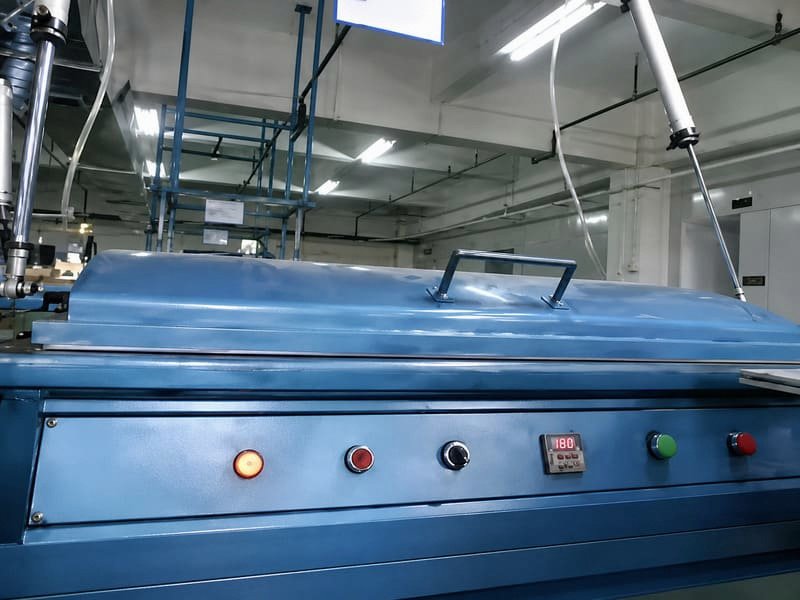
- Molding and Curing Ovens: The long ovens where the liquid PVC is baked into a solid mat.
- Trimming and Finishing Stations: Workers cleaning, trimming, and inspecting the final products.
- Are the machines running? Are there employees actively working? An empty, silent factory floor is a cause for concern.
- Mold Library: This is a critical asset for an OEM/ODM manufacturer. A factory that has been in business for years will have a large room or yard filled with steel or aluminum molds from previous projects. Ask them to show you their mold storage. This is something a trading company can almost never replicate. Our large library of existing molds is a key advantage, as it allows us to offer lower MOQs and faster development times for clients.
| What to Look For | Genuine Mat Manufacturer | Trading Company / Fake Factory |
|---|---|---|
| Production Floor | Active machines, workers, noise of production | Empty, silent, or a small, messy workshop |
| Raw Materials | Large quantities (drums, pallets) in a dedicated warehouse | Small quantities or no stock visible |
| Mold Storage | A large library of physical molds | Few or no molds, evasive answers when asked to see them |
| Finished Goods | A section with products being inspected and packed | Limited stock, or goods that look inconsistent |
A video tour is an invaluable tool. It cuts through the marketing and gives you a real-time glimpse into the supplier's capabilities, helping you confidently identify a genuine mat manufacturer.
What Technical Questions Can Expose a Fake Supplier?
You might be talking to a very polished and friendly sales representative who assures you they can meet all your requirements. However, sales talk is cheap. A representative from a trading company is often trained to say "yes" to everything, without a deep understanding of the production challenges or material limitations involved. This can lead to major disappointments when the final product fails to meet your specifications.
To cut through the fluff, you need to test their technical expertise. Ask specific, detailed questions about the manufacturing process, material science, and quality control. The depth and confidence of their answers will quickly reveal whether you are speaking with an experienced professional from a genuine mat manufacturer or a salesperson reading from a script.
Dive Deeper: The Litmus Test of Expertise
A true manufacturing partner should be a consultant, not just an order-taker. They should be able to guide you on the best materials and processes to achieve your desired outcome. I've found that the best suppliers are eager to talk about the technical details because it's their area of expertise.
Here are some examples of technical questions you can ask, tailored for a mat manufacturer:
- Material Properties: "You offer both PVC and silicone for barber mats. For a mat that needs to resist high heat from clippers and provide excellent grip for tools, which do you recommend and why? What is the maximum continuous temperature each material can handle?"
- Color Matching: "Our brand uses a specific Pantone color, 18-1663 'Fiery Red'. How do you ensure color accuracy between the digital proof and the final PVC product? What is your typical tolerance for color variation?"
- Production Tolerances: "For a 600mm x 400mm bar mat, what is your standard dimensional tolerance after molding and cooling? What causes shrinkage and how do you control for it?"
- Problem Solving: "We've had issues with mats from other suppliers warping or curling at the edges over time. What in your production process prevents this from happening? Is it a material formulation or a curing process issue?"
- Feature-Specific Questions: "We need a mat with magnetic zones to hold barber clippers. How do you integrate the magnets into the mat? Are they co-molded or inserted after? How do you ensure they don't come loose?"
Good answers will be specific, use technical terms correctly, and might even involve their engineering team. They will explain the "why" behind their recommendations. For example, they might say, "We recommend silicone for high-heat applications as it can withstand up to 220°C, whereas our standard PVC is rated for 80°C. We use a specific molding process to prevent warping by ensuring an even curing temperature across the entire mat."
Bad answers are vague and evasive. They often sound like "Yes, no problem," "We are very good quality," or "Don't worry, we can do it." A lack of detail signals a lack of expertise and control over the production process.
Why is Financial Verification a Critical Step?
You've done your research and the supplier seems legitimate. Now it's time to talk money. How you make your first payment is one of the most important steps in the verification process. Many sourcing scams revolve around fraudulent payment requests, where money is diverted to an untraceable account. Falling for this can mean losing your entire deposit with no legal recourse.
A simple but non-negotiable rule is to only transfer funds to a corporate bank account that directly matches the verified name of the manufacturer. A genuine mat manufacturer operates as a legal business entity and will have official, registered bank accounts and invoicing procedures. Any deviation from this is an enormous red flag.

Dive Deeper: Following the Money Trail
Financial transactions leave a clear paper trail, and this trail is your best protection against fraud. Here’s how to ensure your payments are secure and your partner is legitimate.
The Corporate Bank Account Test
When you receive the proforma invoice (PI) for a sample or deposit, scrutinize the banking details. The beneficiary name on the bank account must be the exact same as the full company name on your contract and their business license.
- Warning Sign #1: Personal Accounts. If the supplier asks you to pay an individual's personal bank account (e.g., "Mr. Lee" or "Ms. Chen"), stop immediately. This is the most common method for fraud. They might claim it's "faster" or "avoids taxes," but the real reason is that the funds are untraceable to the company, and you have zero legal protection.
- Warning Sign #2: Mismatched Company Names. Be wary if they ask you to pay a different company, such as a "Hong Kong trading subsidiary." While some large corporations have complex structures, for most direct-from-factory sourcing, the payment should go to the mainland China manufacturing entity. Paying a third-party company breaks the legal link between your payment and your product order.
Invoices and Payment Terms
The professionalism of their financial documents and practices also speaks volumes.
- Official Invoices (Fapiao): In China, legitimate companies can issue official invoices known as "fapiao." These are government-regulated and serve as proof of a legitimate business transaction. While not always required for export, a supplier's ability and willingness to provide one is a strong sign of legitimacy.
- Payment Terms: A genuine mat manufacturer typically has the financial stability to begin production with a deposit, commonly 30-50%. They will request the final balance payment after production is complete and before shipment. A supplier demanding 100% payment upfront for a large custom order may be under-capitalized or a scam, as they are asking you to bear all the financial risk.
Insisting on these financial best practices isn't being difficult; it's being a smart and diligent buyer.
How Do Samples and Factory Audits Provide Final Proof?
All the research and video calls in the world cannot replace the certainty that comes from holding a product in your hands or seeing a factory with your own eyes. Digital communication can hide subtle flaws in quality or large gaps in capability. To make a final, confident decision, you must move from the digital world to the physical one.
The ultimate verification methods are ordering a physical sample and, for large-scale partnerships, conducting an on-site factory audit. A sample allows you to test the supplier's quality, attention to detail, and ability to follow instructions. An audit provides irrefutable proof of their capacity, systems, and compliance. These final steps are what separate a potential supplier from a trusted, genuine mat manufacturer.

Dive Deeper: The Ultimate Reality Checks
These final steps require a small investment of time and money, but they can save you from a catastrophic investment in a large order of substandard products.
The Power of a Physical Sample
Ordering a custom sample is a mini-test of the entire partnership. It's not just about the product itself. Pay attention to the entire process:
- Communication: How clearly did they understand your design specifications?
- Lead Time: Did they meet their quoted sample lead time? (At SuperfectCraft, our standard is 7 days).
- Execution: Does the sample match the artwork? Is the color correct? Is the logo crisp? Is the material quality what you expected? Are the edges clean?
- Packaging: Was the sample packed professionally to prevent damage during shipping?
When I receive a sample, I don't just look at it—I abuse it. I test its durability, flexibility, and any special features. This small investment tells me everything I need to know about the quality I can expect from a mass production run.
When and How to Conduct a Factory Audit
For any significant order or if you're looking for a long-term OEM/ODM partner, a factory audit is essential. You can either visit yourself or hire a reputable third-party inspection company in China to do it for you. An audit is your opportunity to verify everything you've been told.
An auditor will typically check:
- Quality Management System (QMS): Do they have documented processes for incoming material inspection, in-process quality control, and final product inspection?
- Production Capacity: Do the number of machines and workers match their claims? Can they realistically handle your order volume?
- Social Compliance: Are working conditions safe and ethical? This is critical for brands concerned with their supply chain reputation.
- R&D and Engineering: Do they have an actual design and engineering team, or are they just executing basic designs? Our 24-hour design sketch service is a testament to our in-house capabilities.
An audit provides the final piece of the puzzle. It confirms that the impressive factory you saw on the video tour is real, that their quality systems are robust, and that you are partnering with a reliable and genuine mat manufacturer capable of bringing your project to life.
Frequently Asked Questions
What's the difference between a manufacturer and a trading company?
A manufacturer is a factory that physically produces the goods. They have their own production lines, equipment, and workers. A trading company is a middleman that buys products from a factory and resells them. Working directly with a genuine manufacturer gives you more control over customization, quality, and cost, and allows for more direct technical communication.
Is a low MOQ always a red flag when looking for a manufacturer?
Not necessarily. An extremely low MOQ for a fully custom-molded product can be a red flag, suggesting it's a small workshop. However, an established manufacturer with a large library of existing molds, like us at SuperfectCraft, can often offer a low MOQ (e.g., 200 pcs) for designs that use those molds. This is a sign of efficiency, not weakness.
Why can't I just pay a personal bank account to make it faster?
Paying into a personal bank account is extremely risky. It offers you zero legal protection or recourse if the supplier disappears or sends you faulty goods. The payment is not officially linked to the business entity, making it nearly impossible to dispute. Always insist on paying to a corporate bank account that matches the company's registered name.
How much does a third-party factory audit in China typically cost?
The cost for a one-day factory audit in China from a reputable inspection firm usually ranges from $300 to $1,000 USD. The price depends on the location of the factory and the depth of the audit (e.g., simple verification vs. a full social compliance audit). This is a small investment to protect a much larger purchase order.
Conclusion
Verifying a supplier is not about being mistrustful; it's about being diligent. By systematically working through these checks, you can confidently distinguish a well-marketed trading company from a true production partner. The process involves starting with online research, escalating to a live video tour to see their operations, testing their knowledge with technical questions, securing your investment through proper financial channels, and finally, confirming quality with physical samples and on-site audits. Each step builds a layer of security, ensuring that the partner you choose is a genuine mat manufacturer capable of meeting your standards. This due diligence is the foundation of a successful, long-term sourcing relationship built on transparency and trust.
If you're looking for a transparent and verified OEM/ODM partner for your custom bar, barber, or tool mat project, our team at SuperfectCraft is ready to demonstrate our capabilities. We welcome your scrutiny. Contact us today for a free design sketch or to schedule a live video tour of our Dongguan facility.
Whatsapp: +86 15816822766
Email: sales01@superfectcraft.com
Contact Us: https://babarmat.com/contact/