
Are you trying to source custom bar mats but feel overwhelmed by material choices and safety regulations? The term food-grade PVC often comes up, but it's surrounded by confusion and misinformation, leaving you worried about compliance and brand safety. The solution is to understand exactly what this material is, how it's regulated, and why it's often the best choice for your project.
Food-grade PVC is a specialized formulation of polyvinyl chloride designed for safe contact with food and beverages. Unlike standard PVC, it is made from high-purity virgin resin and uses non-toxic, phthalate-free plasticizers. To earn the "food-grade" designation, the final product must pass rigorous migration tests to ensure no harmful substances leach out, making it a compliant and cost-effective material for items like bar mats.
Now that you have the direct answer, you might be wondering what specific tests it must pass or how it truly differs from the cheaper, standard PVC you see everywhere. Let's dive deeper into the science and regulations that define this essential material.
How Is Food-Grade PVC Different from Standard PVC?
Are you tempted to use standard PVC for your products to save on costs? This decision could expose your customers to harmful chemicals and put your brand's reputation at serious risk. Understanding the fundamental differences between industrial PVC and food-grade PVC is not just technical—it's critical for your business.
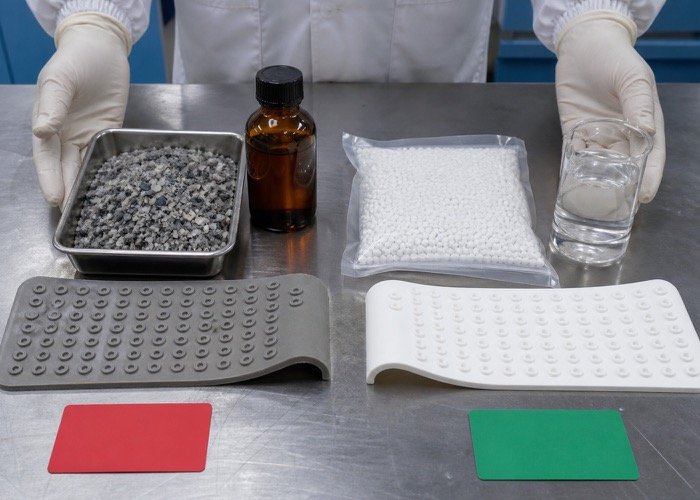
The primary differences are found in three key areas: the purity of the base resin, the type of chemical additives (plasticizers) used to make it flexible, and the mandatory safety testing it must undergo to be legally compliant for food-contact applications.
Dive Deeper: The Critical Distinctions
Let's break down the composition and manufacturing to see why these two materials are worlds apart.
H3: The Role of Plasticizers: Phthalates vs. Non-Phthalates
Rigid PVC, like the kind used for pipes, is hard and brittle. To make it soft and flexible for products like bar mats, manufacturers add chemicals called plasticizers.
-
Standard PVC often uses plasticizers called phthalates (like DEHP, DBP, and BBP). For decades, these were the industry standard because they are cheap and effective. Echter, extensive research has linked certain phthalates to serious health concerns, including acting as endocrine disruptors that can interfere with the body's hormones. This is why their use is now heavily restricted in many products, especially those for children or food contact.
-
Food-Grade PVC, by contrast, must be phthalate-free[^1]. It uses modern, non-toxic plasticizers instead. A common and safe alternative is a chemical called DOTP (Dioctyl Terephthalate), which is not a phthalate and has been approved for food-contact applications by major regulatory bodies. Other bio-based plasticizers derived from plant sources are also gaining popularity. This switch is the single most important factor in making the material safe.
H3: Virgin Resin vs. Recycled Content
The source of the PVC polymer itself is another crucial difference.
-
Standard Industrial PVC can be made with a significant percentage of recycled material. While great for sustainability in non-critical applications like flooring or cable insulation, using recycled content for food-contact items is risky. You can't be certain about the origin of the recycled plastic or what contaminants it might contain from its previous life.
-
Food-Grade PVC is made exclusively from 100% virgin (new), high-purity resin. This guarantees a clean, consistent, and traceable base material free from unknown contaminants, heavy metals, or residual chemicals from a prior use cycle.
H3: Comparing the Two Materials
This table summarizes the key differences for quick reference:
| Functie | Standard PVC | Food-Grade PVC |
|---|---|---|
| Base Resin | Can contain recycled content | 100% virgin, high-purity resin |
| Plasticizers | Often contains phthalates (e.g., DEHP) | Phthalate-free (e.g., uses DOTP) |
| Safety Testing | Not required for food contact | Mandatory migration testing (FDA, LFGB)[^2] |
| Common Uses | Pipes, flooring, electrical cables | Bar mats, food container seals, medical tubing |
| Cost | Lower | Higher |
What Tests Must Food-Grade PVC Pass?
Thinking you can just call your product "food-safe" without proof? This is a dangerous assumption that can lead to product seizures, legal penalties, and irreparable damage to your brand. To be legally compliant, a material must be validated by objective, scientific testing.
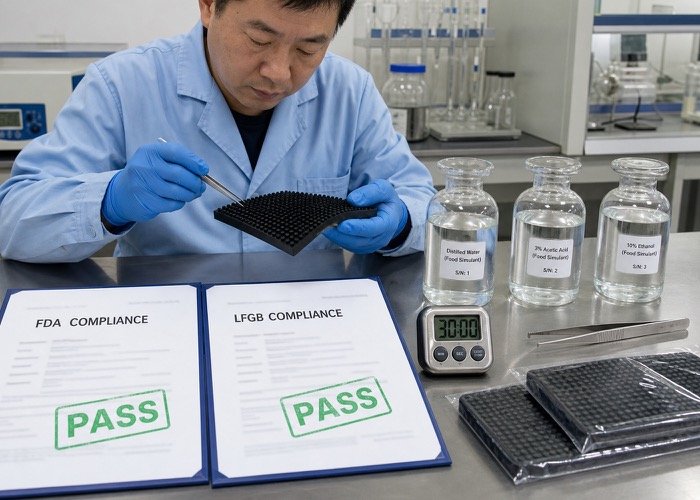
A product made from food-grade PVC must pass specific migration tests defined by regulatory bodies like the FDA in the United States or under REACH and LFGB standards in the European Union. These tests are designed to measure if any chemical substances can "migrate" from the plastic into different types of food under simulated conditions.
Dive Deeper: The World of Regulatory Compliance
Claiming a material is "food-grade" is easy. Proving it requires passing a gauntlet of tests based on your target market. As a manufacturer, I guide my clients through this process every day. Here are the standards that matter most.
H3: Understanding Migration Testing
Migration testing is the core of food-contact material safety. The principle is simple:
- The finished product (e.g., a piece of a bar mat) is submerged in a food simulant. These are liquids designed to mimic different food types. Common simulants include 10% ethanol for water-based drinks, 50% ethanol for alcoholic beverages, and acetic acid for acidic foods.
- The sample remains in the simulant for a specific duration and temperature, meant to replicate worst-case usage scenarios.
- After the exposure period, scientists analyze the liquid simulant to detect and quantify any chemicals that have leached out of the plastic.
- The amount of any migrated substance must be below the strict legal limit, often measured in parts per billion (ppb). If it passes, it can be certified as safe for its intended use.
H3: Key Global Standards for Food-Grade PVC
The specific tests required depend on where you plan to sell your product.
-
FDA (U.S. Food and Drug Administration): In the United States, materials intended for food contact are regulated under the Code of Federal Regulations, specifically CFR Title 21. These regulations list approved substances (resins, plasticizers, additives) that can be used in food-contact plastics and set the limits for migration.
-
EU Regulations (LFGB & BEREIK): In Europe, the process is governed by several overlapping regulations. The Framework Regulation (EC) 1935/2004 is the main directive, stating that materials must not transfer their constituents to food in quantities that could endanger human health.
- LFGB is the German Food and Feed Code. It is known for its extremely strict standards, and an LFGB certification is considered a mark of high quality across Europe.
- BEREIK (Registration, Evaluation, Authorisation and Restriction of Chemicals) restricts the use of specific harmful chemicals. Phthalates, for example, are listed as Substances of Very High Concern (SVHCs) under REACH[^3] and are heavily controlled. A product must comply with REACH to be sold in the EU.
-
California Proposition 65 (Prop 65): This is a state-level law in California that requires businesses to provide warnings on products containing chemicals known to cause cancer or reproductive toxicity. Many phthalates are on this list.[^4] Using compliant, phthalate-free food-grade PVC is the most effective way to avoid the need for a Prop 65 warning label, which can deter customers.
Bij SuperfectCraft, we regularly arrange third-party testing for clients targeting the US, EU, or Amazon marketplaces to ensure their products meet all necessary standards.
Why Use Food-Grade PVC for Bar Mats?
You're a brand owner or procurement manager balancing cost, appearance, durability, and safety for a promotional campaign. Making the wrong material choice can lead to a product that fails quickly or, worse, creates a safety liability. So why is food-grade PVC the professional's choice for bar mats?
The answer is simple: food-grade PVC offers the ideal combination of beverage-contact safety, unmatched branding and customization potential, excellent durability for a busy bar environment, and superior cost-effectiveness for mass production. It hits the sweet spot for promotional and functional barware.
Dive Deeper: The Perfect Material for the Job
I've produced millions of bar mats over the years, and for most applications, food-grade PVC remains the undisputed champion. Here’s a breakdown of why it works so well.
H3: Safety and Compliance are Non-Negotiable
Think about a bar mat's life. Bartenders assemble cocktails over it. Spilled beer, spirits, and citrus juice pool on its surface. Glassware fresh from the dishwasher is placed there to dry. It is, by definition, an indirect food-contact surface. Using a material that isn't certified food-safe is a massive liability. A compliant food-grade PVC mat ensures that if a lime wedge or an ice cube touches the mat before going into a drink, it's not picking up harmful chemicals. This protects consumers and insulates your brand from risk.
H3: Unmatched Customization for Branding
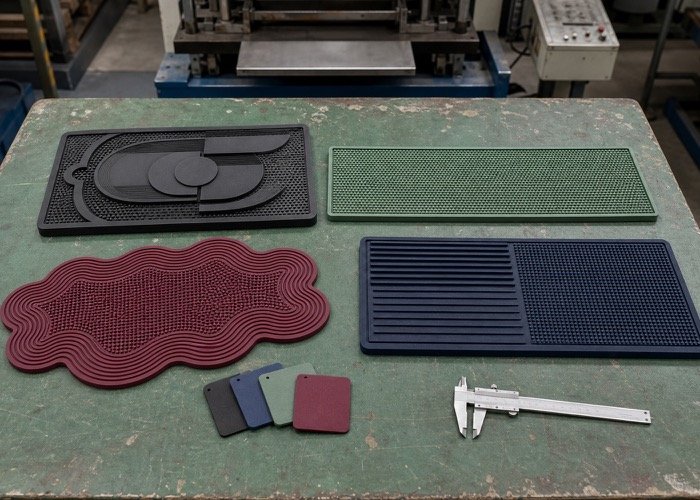
This is where PVC truly shines for OEM/ODM projects. The material is liquid during the molding process, allowing it to capture incredibly fine details.
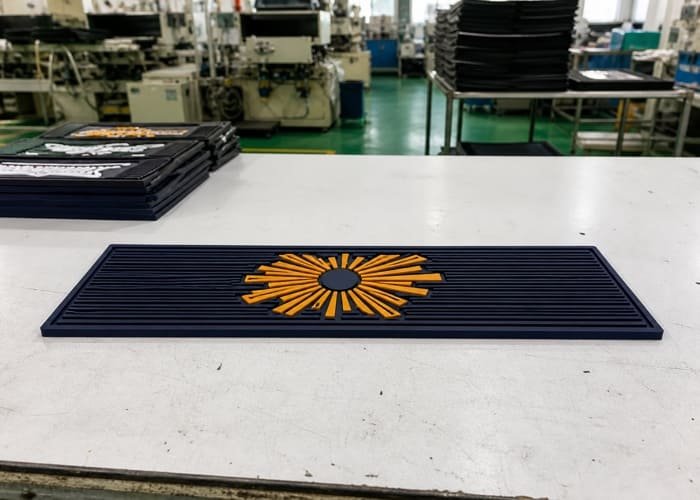
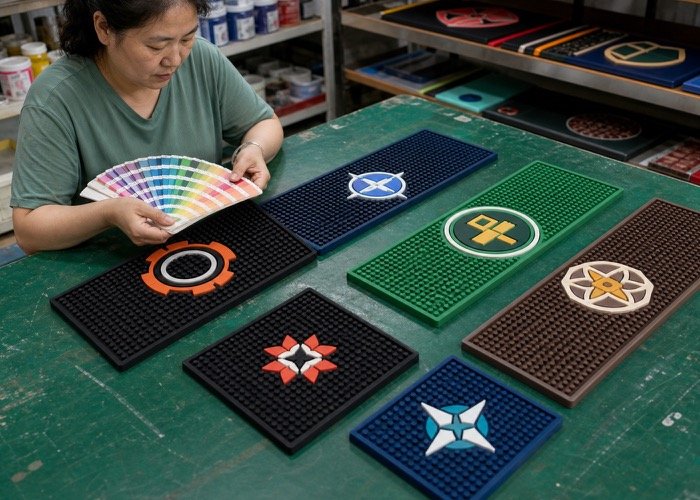
- Intricate Logos: We can reproduce complex 2D or 3D logos with sharp, clean lines that are impossible to achieve with other materials.
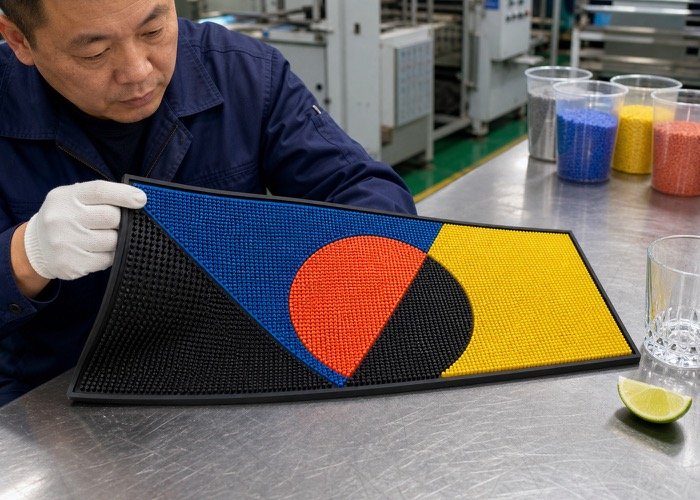
- Vibrant, Separated Colors: The liquid PVC is dispensed color by color, resulting in vibrant, distinct color zones with no bleeding. Your brand colors will be perfectly matched and pop off the mat.
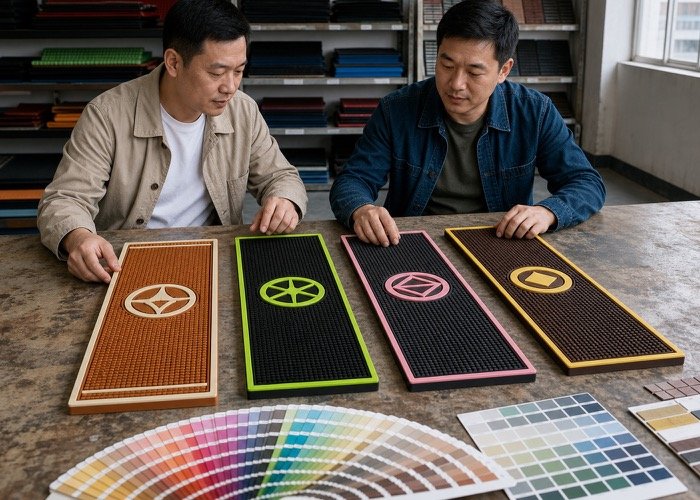
- Flexible Design: We can create custom shapes, maten, and surface textures. Our 24-hour design sketch service allows clients to see their vision come to life almost immediately, even if they don't have a designer on staff.
I remember working with a beverage client who was hesitant about PVC. Once they saw a sample comparing the logo detail on a PVC mat versus a rubber one, the decision was made instantly. The PVC version was simply on another level for brand representation.
H3: Excellent Durability and Functionality
Bar mats need to be tough. Food-grade PVC is:
- Heavy and Non-Slip: It stays put on the bar top.
- Waterproof and Easy to Clean: A simple rinse with soap and water is all it takes.
- Designed for Drainage: We mold in rubber nubs or deep channels that collect spills, keeping the bar surface dry and glassware stable.
H3: Superior Cost-Effectiveness
While silicone and rubber have their place, food-grade PVC generally offers the best performance-to-cost ratio, especially for large orders. The molding process is efficient, and material costs are more stable, making it the most budget-friendly compliant option for promotional campaigns or large-scale distribution.
When Should You Choose Silicone or Rubber Instead of Food-Grade PVC?
While food-grade PVC is a fantastic and versatile material, it isn't a silver bullet for every single application. Using it in an environment it wasn't designed for can lead to warping, kraken, and premature failure, reflecting poorly on your brand.
You should opt for silicone or rubber instead of food-grade PVC for any application that involves direct high heat, prolonged outdoor use with UV exposure, or a need for extreme physical toughness and abrasion resistance. Silicone is the champion of heat resistance, while rubber provides superior mechanical durability.
Dive Deeper: Choosing the Right Tool for the Job
As a manufacturer, my goal is to provide the best material for the client's specific need, not just to sell one type of plastic. Here is when I recommend clients upgrade from PVC to silicone or rubber.
H3: High-Temperature Applications
This is the most common reason to switch. PVC has a relatively low heat tolerance. It will begin to soften and deform at temperatures above 65–80°C (150–175°F).
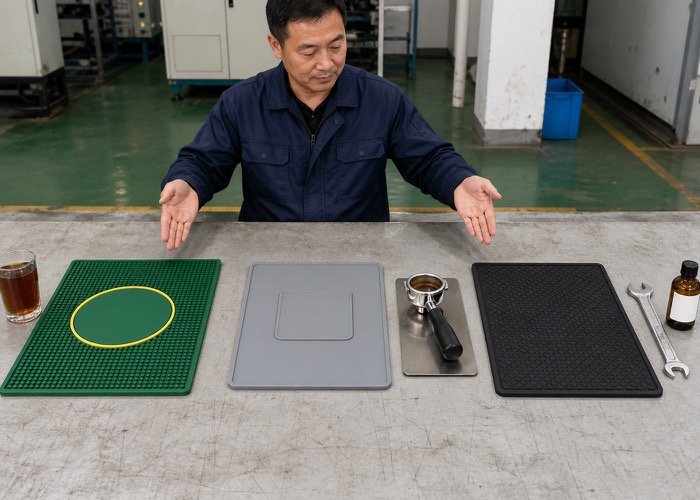
- Choose Silicone: If the mat will be used as a tamping station for hot espresso portafilters, placed near a grill, or have hot pans set on it, silicone is the only choice. Food-grade silicone is stable at temperatures up to 230°C (450°F)[^5] and will not melt or leach chemicals.
H3: Outdoor Use and UV Exposure
If your mats are intended for a permanent patio bar, an outdoor event series, or any environment with constant, direct sunlight, PVC may not be the best long-term option.
- Choose Rubber or UV-Stabilized Silicone: Standard PVC can become brittle and the colors can fade over time with heavy UV exposure. While UV stabilizers can be added to PVC formulations to improve performance, materials like EPDM rubber or specific grades of silicone offer inherently superior resistance to sun damage and are better suited for permanent outdoor installations.
H3: Extreme Physical Durability and Chemical Resistance
While PVC is durable for a bar environment, heavy industrial or workshop settings present a greater challenge.
- Choose Nitrile Rubber: For a mechanic's tool mat that will be constantly scraped with metal tools and exposed to oils, grease, and solvents, nitrile rubber is a far better choice. It offers superior abrasion resistance, tear strength, and resilience against a wider range of chemicals than PVC.
H3: Material Selection Guide
Use this table to make a quick decision based on your primary requirement.
| Materiaal | Best For... | Hittebestendigheid | UV Resistance | Cost |
|---|---|---|---|---|
| Food-Grade PVC | Branding, general bar use, cost-effectiveness | Laag | Gematigd | $$ |
| Siliconen | High-heat contact, medical/food applications | Zeer hoog | Goed | $$$$ |
| Nitrile Rubber | Industrial durability, oil/chemical resistance | Hoog | Uitstekend | $$$ |
Veelgestelde vragen
Is food-grade PVC safe for microwaves?
Nee, you should never put food-grade PVC in a microwave. While the material is safe for food contact at room temperature, it is not designed to withstand high heat. Microwaving it can cause the plastic to warp, melt, and potentially release chemicals. Always use materials specifically labeled as "microwave-safe," like glass, ceramic, or certain grades of silicone.
Can you recycle food-grade PVC?
Technically, PVC is recyclable, but it is very difficult in practice. It must be separated from all other types of plastic, and because it contains different additives than standard PVC, it complicates the recycling stream. Most municipal recycling programs do not accept flexible PVC products like bar mats.
How do I clean a food-grade PVC bar mat?
Cleaning is simple. Just take the mat to a sink and wash it with warm water and standard dish soap. A soft brush can be used to scrub any residue out of the crevices or around the logo details. Rinse thoroughly and let it air dry. Avoid using harsh solvents, bleach, or abrasive cleaners, as they can damage the material's surface over time.
Is "phthalate-free" the same as "food-grade"?
Not necessarily. Being "phthalate-free" is a critical requirement for a PVC product to be considered food-grade, but it is not the only one. A truly food-grade product must also be made from 100% virgin resin and, most importantly, must have passed comprehensive migration testing according to regulations like FDA or LFGB. "Phthalate-free" only describes one component.
Conclusie
Ultimately, food-grade PVC is not just another plastic. It is a highly specific, regulated, and safe material engineered for applications where contact with beverages and food is a daily reality. By using pure virgin resin, replacing harmful phthalates with safe alternatives, and validating its safety through rigorous migration testing, it stands apart from standard industrial PVC. For any brand looking to create vibrant, duurzaam, and custom-branded bar mats, it provides the perfect balance of compliance, performance, and cost-effectiveness. Understanding this difference is the first step toward sourcing a product that is not only beautiful but also responsible.
If you're looking to create custom, compliant bar mats that represent your brand perfectly, our team at SuperfectCraft is here to help. With our deep expertise in food-grade PVC and other advanced materials, we can guide you to the perfect solution for your project. Contact us today for a free design sketch and a no-obligation quote!
[^1]: "Phthalates in Food Packaging and Food Contact Applications", https://www.fda.gov/food/food-additives-and-gras-ingredients-information-consumers/phthalates-food-packaging-and-food-contact-applications. FDA has revoked authorizations for numerous phthalates in food-contact applications and continues to evaluate remaining uses, reflecting a regulatory trend to exclude many phthalates from food-contact materials. Bewijs rol: algemene_ondersteuning; brontype: government. Ondersteunt: That regulators have restricted or revoked multiple phthalates for food-contact uses, driving phthalate-free formulations in practice.. Reikwijdte opmerking: Not all jurisdictions categorically prohibit every phthalate in all food-contact uses; some uses remain permitted subject to limits. [^2]: "Guidance for Industry: Preparation of Premarket Submissions for Food ...", https://www.fda.gov/regulatory-information/search-fda-guidance-documents/guidance-industry-preparation-premarket-submissions-food-contact-substances-chemistry. FDA’s Chemistry Recommendations for Food Contact Substance Notifications outline migration testing with relevant food simulants as the standard method to assess exposure and compliance, and German LFGB compliance commonly relies on EU plastic FCM migration tests. Bewijs rol: algemene_ondersteuning; brontype: government. Ondersteunt: That migration testing with appropriate simulants is the standard approach for demonstrating food-contact safety in the U.S. and EU/Germany.. Reikwijdte opmerking: FDA does not mandate a single test protocol for all materials; testing requirements are case- and material-specific. [^3]: "Update of the risk assessment of di‐butylphthalate (DBP), butyl‐benzyl ...", https://pmc.ncbi.nlm.nih.gov/articles/PMC7008866/. ECHA’s Candidate List includes phthalates such as DEHP, DBP, BBP, and DIBP as substances of very high concern based on reproductive toxicity and endocrine-disrupting properties, indicating stringent EU controls. Bewijs rol: algemene_ondersteuning; brontype: institution. Ondersteunt: That certain phthalates are on the ECHA Candidate List of SVHCs due to hazards such as reproductive toxicity and endocrine disruption.. [^4]: "The Proposition 65 List - OEHHA - CA.gov", https://oehha.ca.gov/proposition-65/proposition-65-list. The OEHHA-maintained Proposition 65 list includes several phthalates, such as DEHP, DBP, BBP, and DINP, for cancer and/or reproductive toxicity. Bewijs rol: algemene_ondersteuning; brontype: government. Ondersteunt: That multiple phthalates (e.g., DEHP, DBP, BBP, DINP) are listed under Proposition 65.. [^5]: "Silicone rubber", https://en.wikipedia.org/wiki/Silicone_rubber. Reference descriptions of silicone rubber report typical continuous service temperatures up to roughly 200–250°C, supporting the cited 230°C stability figure. Bewijs rol: algemene_ondersteuning; brontype: encyclopedie. Ondersteunt: That silicone rubber typically retains performance at temperatures in the 200–250°C range.. Reikwijdte opmerking: Actual operating limits vary by silicone formulation and certification.