
Every procurement manager knows the balance between securing high-quality branded materials and staying within budget. When it comes to branded merchandise, your goal is to find ways to reduce custom bar mat purchasing costs without compromising the final product's look or durability. This challenge requires a strategic approach, looking beyond the sticker price to find savings in design, materials, en logistiek.
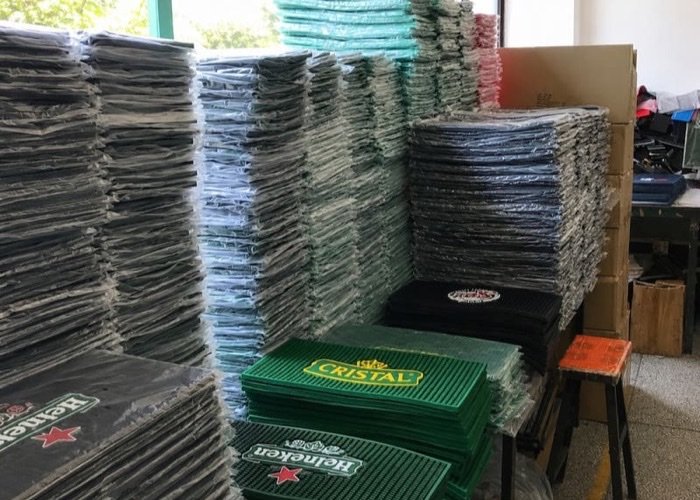
To reduce your custom bar mat purchasing costs, you can take several key actions. These include increasing your order volume, simplifying the mat's design and color scheme, optimizing its dimensions and thickness, choosing cost-effective materials like PVC, and working directly with a manufacturer to eliminate middleman fees. Further savings can be found by reusing existing molds, optimizing shipping, and investing in pre-production samples to avoid costly errors.
While that gives you the quick answer, each of these strategies has nuances that can unlock even greater savings. Let’s dive deeper into each of the ten methods you can use to make your next bar mat order more budget-friendly.
1. How Does Order Quantity Impact Your Custom Bar Mat Purchasing Costs?
You have a fantastic design for a bar mat, but the initial quote for a small batch feels steep. You're worried that a larger order is a bigger financial risk, even if the per-unit price is lower. The key is to understand how economies of scale directly translate into significant savings.
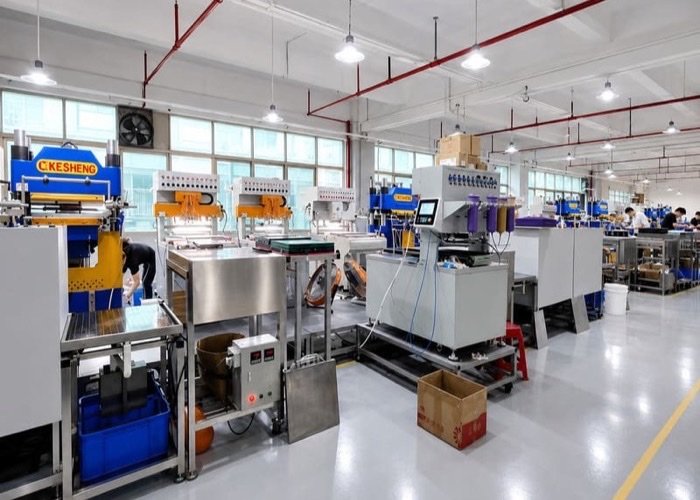
A larger order volume is the most direct way to lower your per-unit cost. Manufacturing involves fixed setup costs, such as mold creation and machine calibration. Spreading these fixed costs over a higher number of units drastically reduces the price of each individual mat.
Duik dieper: The Power of Economies of Scale
When we set up a production run for custom bar mats, a significant portion of the initial effort is identical whether we produce 200 pieces or 2,000 stukken. This initial setup includes:
- Mold Preparation: The cost of creating or preparing your custom mold is a one-time expense.
- Material Mixing: Preparing the specific color and grade of PVC or silicone takes time and resources.
- Machine Calibration: Each new design requires our machines to be calibrated for precise dispensing and molding.
Let's look at a hypothetical cost breakdown to see how this plays out.
| Cost Component | Order of 200 Mats | Order of 2,000 Mats |
|---|---|---|
| Mold & Setup (Fixed) | $500 | $500 |
| Materiaal & Werk (Variable) | $4.00 / mat | $3.80 / mat (bulk discount) |
| Total Cost | $500 + (200 * $4.00) = $1,300 | $500 + (2,000 * $3.80) = $8,100 |
| Cost Per Mat | $6.50 | $4.05 |
As you can see, the per-unit price drops by nearly 38% simply by increasing the order size. The fixed setup cost is "amortized" or spread across many more units. Verder, we can often secure better pricing on raw materials when purchasing them in larger quantities for your project, and we pass those savings on to you. While our MOQ starts at 200 stukken, crossing thresholds like 500, 1,000, of 5,000 units will typically unlock new tiers of pricing.
2. Can Adjusting Mat Specifications Lower Custom Bar Mat Purchasing Costs?
You need a bar mat that fits a specific counter space, but the large size is driving the price up. It feels like you're stuck between functionality and budget. The solution isn't always to shrink the footprint but to smartly adjust all dimensions, including thickness.
Ja, optimizing your mat's dimensions is a powerful lever for controlling costs. Reducing the overall length, width, or thickness directly decreases the amount of raw material needed, which is a primary driver of the final price. Even a small reduction can lead to noticeable savings.

Duik dieper: A Balancing Act of Size, Dikte, and Cost
Material consumption is calculated by volume (Length x Width x Thickness). Therefore, a change in any of these three variables will directly affect the amount of PVC or silicone used.
- Length and Width: These are often determined by the application. A standard bar rail mat has different needs than a large station mat for a barber. Echter, ask yourself if the size can be slightly reduced. Can a 60cm mat work just as well as a 65cm one? Shaving off a few centimeters can make a difference, especially on a large order.
- Dikte: This is often the most flexible variable. A standard bar mat is typically between 8mm and 10mm thick. This provides good weight, stability, and depth for containing spills. Echter, for promotional items or lighter-duty applications, reducing the thickness to 6mm or 7mm can be a viable option.
Here's a practical example:
Let's say a mat measuring 60cm x 10cm x 1cm (10mm thick) requires 'X' amount of PVC. If you reduce the thickness to 0.8cm (8mm), you've just reduced the material required by 20%. This translates into a significant reduction in your custom bar mat purchasing costs.
The key is to match the thickness to the intended use. For a heavy-duty industrial tool mat, a thicker profile is necessary for durability. For a promotional giveaway mat that will see lighter use, a slimmer profile is often perfectly acceptable and much more budget-friendly.
3. Will a Simpler Color Scheme Reduce Your Custom Bar Mat Purchasing Costs?
Your brand guide is filled with beautiful gradients and a dozen colors. You want the mat to be a perfect representation of your brand, but the quote for a multi-color design is high. The frustration is real: do you sacrifice brand accuracy for affordability?
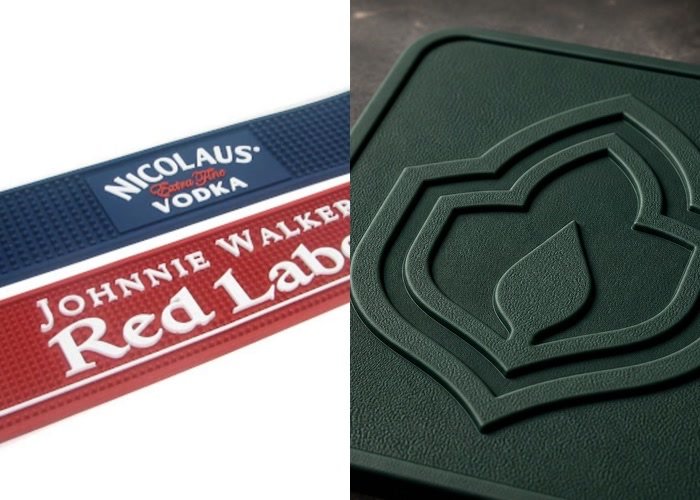
Absolutely. Simplifying your color scheme is one of the most effective ways to lower production costs. Each additional color in a PVC bar mat requires a separate dispensing process and adds complexity and time to production, which directly increases the price.
Duik dieper: The Cost of Color Complexity
In molded PVC mat production, colors are not printed on top; they are dispensed as liquid PVC into the mold, layer by layer. This process, known as "micro-injection" or "dispensing," is meticulous.
- Single-Color Design: For a logo with one color on a black base, the process is straightforward. We dispense the black background, then dispense the single logo color into the designated channels in the mold.
- Multi-Color Design: For a logo with five colors, we must repeat the dispensing process five separate times, one for each color. This involves:
- Precise color matching for each of the five shades.
- Programming the dispensing machine for five different paths.
- Increased labor time to oversee the more complex process.
- Higher risk of error, requiring stricter quality control.
Why Gradients Are a Challenge: True gradients (smooth transitions from one color to another) are not achievable with the standard PVC dispensing method. Simulating a gradient requires many thin lines of different shades right next to each other, which exponentially increases complexity and cost. A full-color design is better suited for mats with a printed surface, which is a different manufacturing technique.
To reduce costs, consider these design tweaks:
- Reduce the color count: Can your 5-color logo be effectively represented in 2 of 3 kleuren?
- Use a monochrome design: A single bold color on a black or colored base can be incredibly striking and is very cost-effective.
- Embrace negative space: Instead of filling a shape with color, let the base color of the mat show through. This counts as one less color to add.
4. How Does Material Selection Affect Custom Bar Mat Purchasing Costs?
You're looking for a high-quality feel but the budget is tight. You hear terms like PVC, siliconen, and rubber, and the price quotes vary wildly. It's confusing to know if paying more for a "premium" material is worth it, or if a more standard option is sufficient.
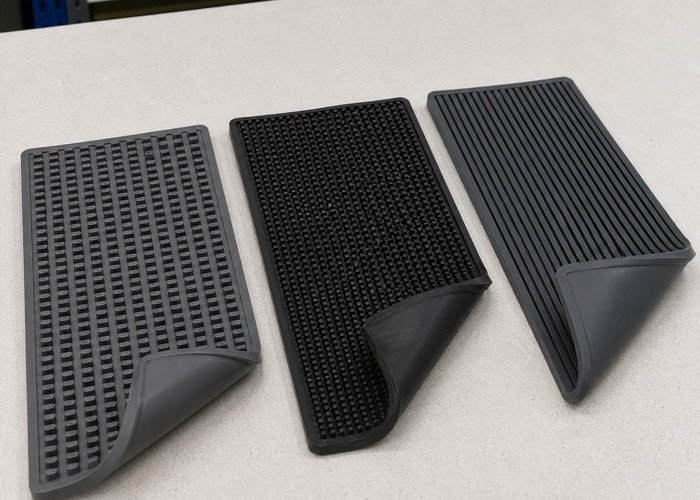
Material selection is a primary factor in your custom bar mat purchasing costs. For most commercial and promotional applications, PVC (Polyvinyl Chloride) is the most cost-effective choice. It offers excellent durability, vibrant color options, and is perfect for intricate logos, all at a lower price point than silicone or natural rubber.
Duik dieper: Choosing the Right Material for Your Budget
Understanding the properties and price points of different materials is crucial for making a cost-effective decision.
PVC: The All-Around Value Leader
PVC is the industry standard for custom logo bar mats for a reason.
- Cost: The raw material is less expensive than silicone or rubber.
- Maatwerk: It's ideal for the micro-injection process, allowing for sharp, detailed, and complex multi-color logos.
- Duurzaamheid: It's tough, resistant to wear and tear, and easy to clean, making it perfect for busy bar environments.
- Our Standard: Bij SuperfectCraft, our standard PVC is non-toxic and safe for all typical bar, barber, and tool mat applications.
Siliconen & Rubber: The Premium & Specialized Options
- Siliconen: This material is more expensive due to its unique properties. It has superior heat resistance and can be formulated to meet food-grade standards like FDA or LFGB. You should choose silicone if your mat will be in direct contact with food or subjected to high temperatures. For a standard bar mat, it's often an unnecessary expense.
- Rubber (Nitrile): Nitrile rubber is known for its excellent resistance to oils, grease, and chemicals. It's heavier and often used for industrial or high-traffic floor mats. While durable, it's less suited for fine logo details and carries a higher cost than PVC.
Here's a simple comparison table:
| Functie | PVC | Siliconen | Rubber |
|---|---|---|---|
| Cost | $ | $$$ | $$ |
| Logo Detail | Uitstekend | Goed | Fair |
| Hittebestendigheid | Goed | Uitstekend | Erg goed |
| Best For | Promotioneel & Bar Use | Food-Grade, High-Heat | Industrieel, Oily Areas |
For over 90% of our clients ordering bar mats, PVC provides the perfect balance of quality, appearance, and affordability. By choosing the material that fits your actual needs—not just a perceived notion of quality—you can significantly control your custom bar mat purchasing costs.
5. What's the Smartest Way to Handle Mold Fees and Lower Costs?
The mold fee in your quote can seem like a large, unavoidable upfront cost. You wonder if there's any way to reduce this initial expense, especially if you plan to reorder in the future. The secret lies in viewing the mold fee not as a cost, but as an investment.
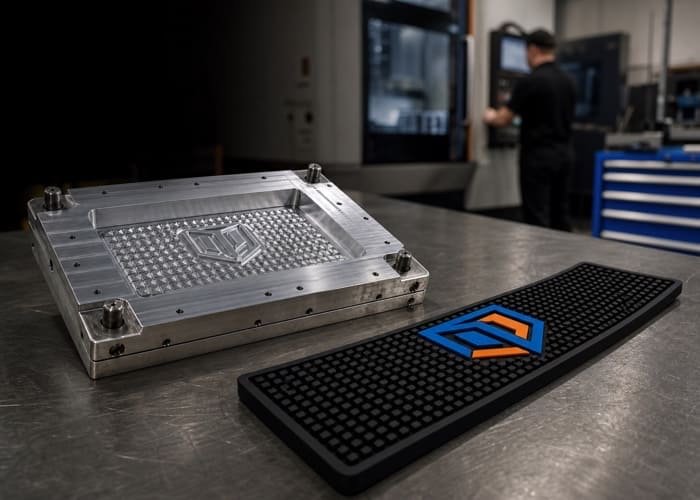
The smartest way to handle mold fees is to amortize them over a larger order. While the fee itself is fixed for a new design, ordering a higher quantity of mats drastically reduces the mold's cost impact on each individual unit, directly lowering your overall purchasing cost per piece.
Duik dieper: Making Your Mold Work for You
A custom mold is a precision-engineered piece of metal that is yours. It's what allows us to perfectly replicate your unique design, logo, and texture on every single mat. This is a one-time charge for a new design.
Here’s how to minimize its impact:
- Think Long-Term: Do you anticipate needing more mats in the next 6-12 maanden? Placing one large order now instead of two smaller orders later eliminates paying for setup twice and gives you a much better price per unit. The mold is stored by us and is ready for your future re-orders, which will not incur another mold fee.
- Calculate the Amortized Cost: Always divide the mold fee by the number of units to see the true cost.
- $500 mold fee / 200 mats = $2.50 per mat
- $500 mold fee / 1,000 mats = $0.50 per mat This simple calculation shows how volume dramatically reduces the mold's impact on your budget.
Can You Avoid Mold Fees Entirely?
Ja, in one specific scenario: using an existing mold. We have a large library of molds for standard-sized mats without logos. If your project simply requires a plain, functional mat in a size we already produce, you can avoid a new mold fee altogether. This is a great option for functional applications where a custom logo isn't necessary. Echter, for any custom branding, a new mold is essential.
By planning your order volume strategically, you can transform the mold fee from a burdensome expense into a negligible part of your overall custom bar mat purchasing costs.
6. Can Reusing Existing Molds Significantly Cut Your Initial Investment?
You need a functional mat quickly and on a tight budget. A fully custom-branded mat isn't a top priority, but you still need a specific size and a professional look. You're wondering if there's a way to skip the custom design process and its associated costs.
Ja, leveraging an existing mold from a manufacturer's library is one of the most effective ways to slash your initial investment. This completely eliminates the new mold fee, which is often one of the largest upfront expenses, and can significantly shorten your production lead time.

Duik dieper: The Benefits of Standard Molds
Bij SuperfectCraft, we have invested in a vast library of molds for various mat sizes and surface textures. These are "open" molds, ready for production at a moment's notice.
When to Choose an Existing Mold:
- Budget is the Top Priority: If your primary goal is to acquire functional mats at the lowest possible cost, this is your best option.
- Speed is Essential: Since the mold is already made, we can skip the 5-7 day mold creation process and move directly to sample or mass production, saving you valuable time.
- Branding is Not Required: This is ideal for utility mats for workshops, unbranded barber station mats, or general-purpose drainage mats where a logo isn't necessary.
How it Works:
- You provide your required dimensions.
- We check our library to see if we have an existing mold that matches or is very close to your size.
- If we have a match, you pay no mold fee. Production can begin almost immediately after you confirm the material and color.
Even if you need a logo, you can still save. We can sometimes use an existing base mat mold and create a smaller, separate "logo mold" that is inserted. This is often cheaper than creating a large, single mold from scratch. By asking your manufacturer about their existing mold options, you can uncover a powerful strategy for reducing your custom bar mat purchasing costs.
7. Why Does Sourcing Directly from a Factory Reduce Your Overall Spend?
You've been getting quotes from local distributors and trading companies. The prices seem reasonable, but you suspect there might be hidden markups. You're looking for a way to get closer to the source and achieve true cost efficiency.
Working directly with a manufacturer like SuperfectCraft is the most reliable way to reduce your overall purchasing costs. It eliminates the markups added by intermediaries like trading companies, importeurs, and distributors, ensuring you pay a price that is much closer to the actual cost of production.

Duik dieper: Cutting Out the Middlemen
The typical supply chain for imported goods can have several layers, with each one adding a percentage to the final price you pay.
- Manufacturer (Us): We produce the mat for Price 'X'.
- Trading Company: Buys from us, adds 10-20% margin, and sells to an importer.
- Importer/Wholesaler: Buys from the trading company, adds 20-40% margin, and sells to a local distributor.
- Local Distributor: Buys from the importer, adds another 20-30% margin, and sells to you, the final buyer.
By the time the product reaches you, the price could be double or even triple the original factory price.
The Benefits of Direct Sourcing:
- Cost Savings: This is the most obvious benefit. You get the product at the "Price X" level, plus shipping.
- Clear Communication: Communicating directly with the production team means your specifications for design, kleur, and materials are understood perfectly. This reduces the risk of errors and misinterpretations that can occur when messages are passed through multiple parties.
- Faster Turnaround: Direct communication speeds up every stage of the process, from design approval and sampling to production updates.
- Greater Control: You have more control over customization, quality checks, and packaging when you are in direct contact with the people making your product.
While working with a local distributor can be convenient, for any company looking to optimize its budget, establishing a direct relationship with a factory is a critical step in managing custom bar mat purchasing costs effectively.
8. How Does Optimizing Your Shipping Strategy Lower Long-Term Purchasing Costs?
You've successfully negotiated a great price for your mats, but the shipping quote makes you wince. The cost of logistics can quickly erode your hard-won savings, making you wonder if there's a more efficient way to get your products from the factory to your warehouse.
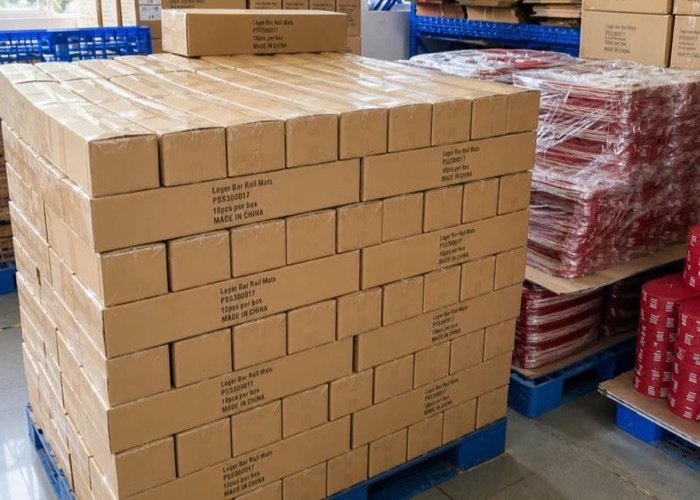
Optimizing your shipping strategy, primarily by consolidating orders to fill a full container (FCL), can dramatically reduce your per-unit shipping cost. While air freight is fast, ocean freight is far more economical for bulky items like bar mats, and FCL shipping offers the best possible rates.
Duik dieper: FCL vs. LCL and Other Shipping Considerations
Understanding the language of international shipping is key to saving money.
- FCL (Full Container Load): You pay a flat rate to use an entire 20-foot or 40-foot shipping container. This is the most cost-effective method if you have enough volume to fill it (or mostly fill it). The cost per cubic meter is significantly lower than LCL.
- LCL (Less than Container Load): Your goods share space in a container with products from other companies. While it allows you to ship smaller volumes, you pay a premium per cubic meter. It also involves more handling at both ports (consolidation and de-consolidation), which can increase the risk of delays and damage.
How to Optimize:
- Plan Ahead for FCL: This goes back to a previous point: order volume. If you can forecast your needs for a year, you might find that placing one or two large FCL orders is cheaper overall than placing four smaller LCL orders.
- Understand Volumetric Weight: Bar mats are not particularly heavy, but they are bulky. Shippers charge based on "volumetric weight," which is a calculation of the space an item occupies. This is why efficient packing is crucial. We work to nest and stack your mats in a way that minimizes wasted space in the shipping cartons.
- Factor in All Costs: A shipping quote includes more than just the ocean freight. It also covers trucking to the port, customs clearance, port fees, and final delivery. Working with an experienced factory like us means we can help you get a clear, all-inclusive quote from reliable freight forwarders.
Strategic shipping isn't just about finding the cheapest carrier; it's about planning your order cycles and volumes to take advantage of the most economical shipping methods. This long-term view is essential for truly minimizing your total purchasing costs.
9. Does Investing in Samples Actually Save Money on Your Final Order?
You're on a tight deadline and an even tighter budget. The thought of spending time and money on a pre-production sample seems like an unnecessary delay and expense. You're tempted to approve the design sketch and go straight to mass production to save a week.
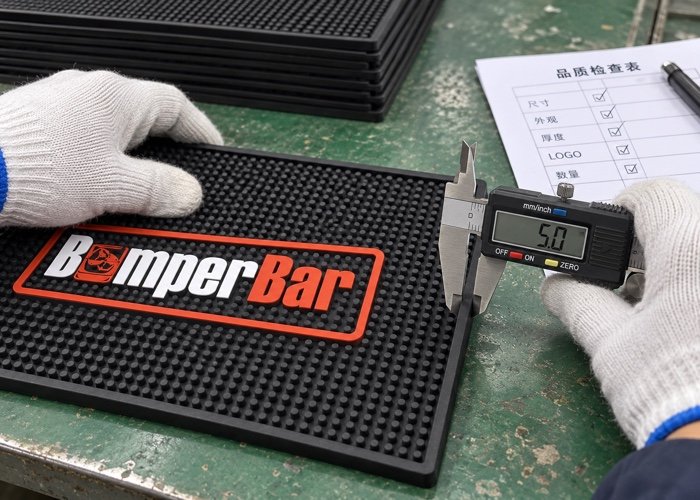
Investing in a pre-production sample is one of the most critical risk-management steps you can take, and it almost always saves money in the long run. A physical sample allows you to verify color, textuur, weight, and overall quality before committing to a full production run, preventing costly mistakes and re-runs.
Duik dieper: The High Cost of "Getting it Wrong"
Imagine ordering 2,000 bar mats and, upon arrival, discovering the main color of your logo is a slightly wrong shade that doesn't match your other branding. Or perhaps the mat feels lighter and flimsier than you expected. The cost to fix this issue would be catastrophic:
- The entire order might be unusable.
- You would have to pay for a full re-production run.
- You would lose valuable time and miss your marketing or event deadlines.
The relatively small cost of a sample (typically a few hundred dollars, covering mold setup and express shipping) is a tiny insurance policy against this multi-thousand-dollar risk.
What to Check with Your Sample:
- Color Accuracy: A digital proof on a screen can look very different from a physical Pantone-matched color in PVC. This is your only chance to confirm the colors are perfect.
- Logo Detail and Quality: Does the logo have sharp, clean lines? Is the dispensing work neat?
- Material Feel and Weight: Does the mat have the heft and flexibility you envisioned? Does the surface texture feel right?
- Dimensions: Confirm the length, width, and thickness match your specifications exactly.
Our process always includes a sample confirmation step. We create a prototype based on your approved artwork and send it to you for physical inspection. Only after you provide your unequivocal approval do we proceed with mass production. This step removes all ambiguity and ensures the final product you receive is exactly the product you wanted, safeguarding your investment and preventing any negative impact on your custom bar mat purchasing costs.
10. Will a Simpler Logo Application Method Reduce Your Custom Bar Mat Purchasing Costs?
You want your logo to be prominent, but you're exploring options beyond the standard multi-color design. You've heard about different techniques like single-color dispensing or debossing and wonder if they offer a more budget-friendly way to display your brand.
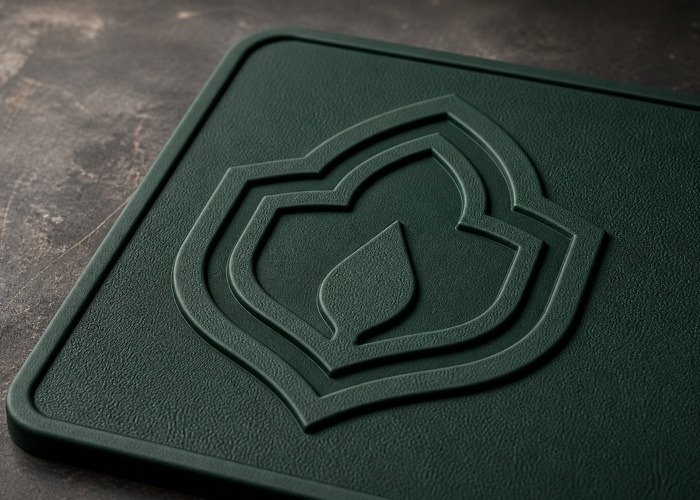
Ja, choosing a simpler logo application method, such as a single-color dispensed logo or a debossed/embossed design, is a highly effective strategy for reducing custom bar mat purchasing costs. These methods simplify the production process, using less labor and fewer materials than complex, multi-color logos.
Duik dieper: Cost-Effective Branding Techniques
While a vibrant, multi-color logo is eye-catching, several other professional and stylish methods can deliver a premium look for a fraction of the cost.
Single-Color Dispensing
As discussed earlier, reducing the color count is a major cost-saver. A single, bold logo color on a contrasting background base is a classic, powerful look.
- Proces: This involves just one color dispensing step after the base is laid.
- Benefit: It dramatically reduces setup time, labor, and the potential for errors. It's the sweet spot between full branding and minimal cost. I recall a craft brewery client who switched from a 4-color logo to a simple white-on-black design; they cut their per-unit cost by nearly 25% and loved the bold, minimalist aesthetic.
Debossed or Embossed Logos
This technique creates a 3D effect without using a different color.
- Debossed: The logo is pressed down into the mat's surface.
- Embossed: The logo is raised up from the mat's surface.
- Proces: The logo shape is part of the main mold itself. The entire mat, including the logo, is made from a single color of PVC poured all at once.
- Benefit: This is the absolute most cost-effective way to include a logo. Since there is no secondary color dispensing, production is incredibly fast and simple. It creates a subtle, high-end "tone-on-tone" look that many premium brands prefer.
By thinking creatively about how your logo is applied, you can achieve a professional, branded look that aligns with a more conservative budget, making a real difference in your final purchasing costs.
Veelgestelde vragen
What is the typical MOQ for custom bar mats?
Our standard Minimum Order Quantity (MOQ) is 200 pieces per design, per color when using an existing mold or creating a new one. This quantity allows us to run production efficiently and offer you a competitive price. Ordering higher volumes will result in a lower per-unit cost.
How long does it take to get a sample?
The typical lead time for a pre-production sample is about 7 dagen. This includes the time needed to prepare the mold, match the colors, and produce the physical mat. We then ship the sample to you via express courier for your approval before proceeding with the bulk order.
Can you help with design if I only have a logo?
Absolutely. We offer a complimentary 24-hour design sketch service. If you provide us with your logo file and desired mat dimensions, our design team will create a professional production-ready artwork proof for your review. This service helps clients who may not have their own in-house design resources.
Do I have to pay for a new mold for every single order?
Nee. The mold fee is a one-time investment for a new design. Once you pay the mold fee, we create and store your custom mold. For all future re-orders of the exact same design and size, there will be no additional mold fee, which significantly reduces the cost of subsequent orders.
Conclusie
Effectively managing your custom bar mat purchasing costs is a game of smart choices, not sacrifices. By focusing on the ten strategies we've outlined—from increasing order volume and simplifying your design to choosing the right material and working directly with a factory—you can achieve significant savings without compromising on the quality and impact of your branded merchandise. The key is to analyze each component of the cost, from the mold fee to the shipping container, and make informed decisions that align with your budget and project goals. A strategic approach empowers you to get the best possible value for your investment.
Ready to get a cost-effective quote for your custom bar mat project? Contact our team at SuperfectCraft today. Let us help you navigate these options and build the perfect, budget-friendly mat for your brand.
- WhatsApp: +86 15816822766
- E-mail: sales01@superfectcraft.com
- Website: www.superfectcraft.com