
Struggling to find the right bar mat for your business? It seems like a simple purchase, but choosing the wrong one leads to smelly, slippery surfaces and a constant need for replacement. You waste money on products that crack, disparaître, and ultimately damage your brand's professional image. The solution is to learn from the common mistakes others have made before you invest.
The most common mistakes first-time bar mat buyers make involve choosing the wrong material, getting the size and specifications wrong, making critical errors in customization and printing, and failing to match the mat's performance features to its intended use. These errors lead to issues like foul odors, poor grip, faded logos, and rapid degradation.
Avoiding these pitfalls is easier than you think. By understanding the details of material science, sizing, et personnalisation, you can confidently select a mat that not only looks great but also functions perfectly for years to come. Let’s dive into the top 10 mistakes so you can make a smarter purchase.
Are You Choosing the Wrong Bar Mat Material?
The material is the foundation of your mat, and getting it wrong is the most frequent and costly mistake. It's tempting to focus only on price, but that often leads to a product that fails spectacularly in a commercial environment.
This is a classic case of "you get what you pay for." A cheap mat might save you a few dollars upfront, but it will cost you more in the long run through replacements, damaged glassware, and even customer complaints. Let's break down the three biggest material-related blunders.
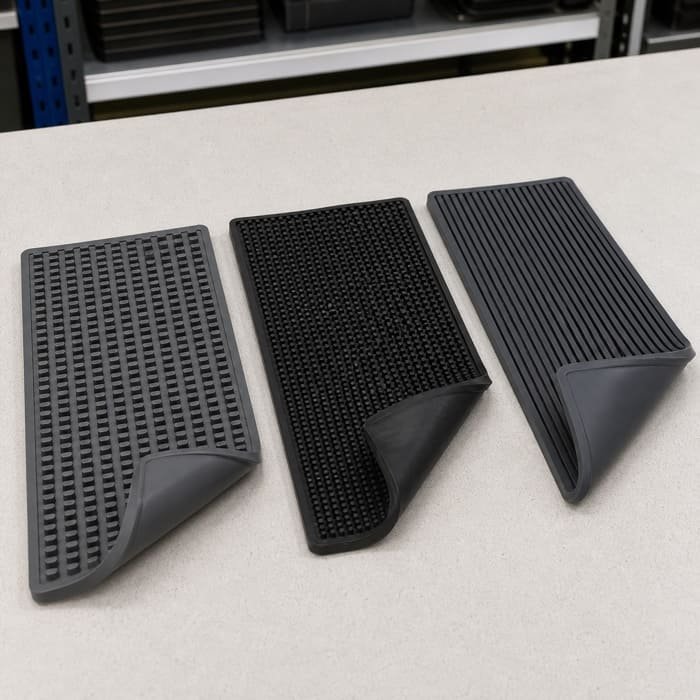
Mistake 1: Opting for Cheap, Smelly Recycled Rubber
Many first-time buyers are lured by the low price of mats made from cheap, recycled rubber. The problem is that these mats often arrive with a pungent, chemical smell that can be incredibly off-putting to both staff and customers. I once had a client who tried this route; they saved 20% on their initial order, but the odor was so strong they couldn't even keep the mats in the building.
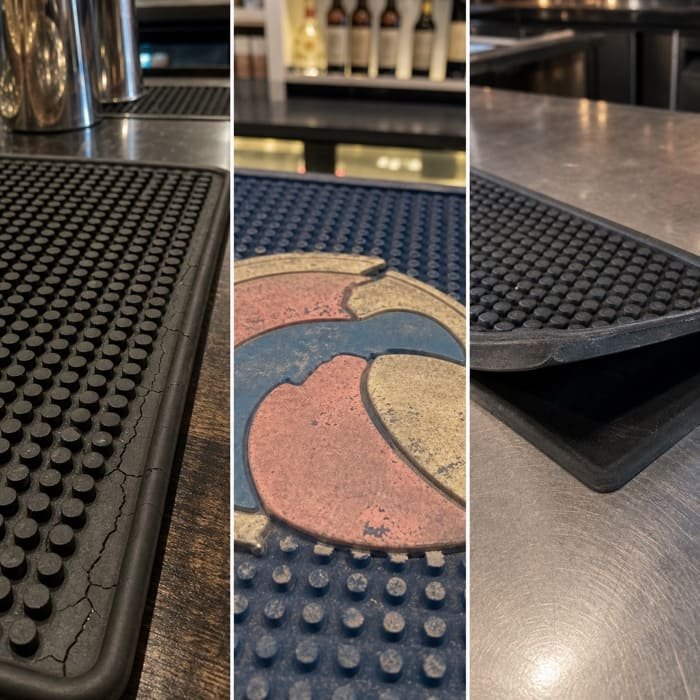
Worse yet, this low-grade rubber degrades quickly. When exposed to spilled drinks and constant wiping, the surface begins to break down, leaving a fine black powder[^1] on your glassware and countertops. The material can also turn whitish or chalky when soaked, making your bar look dirty and unhygienic.
How to avoid this:
- Insist on high-quality materials: Always opt for mats made from food-grade natural rubber or premium silicone.
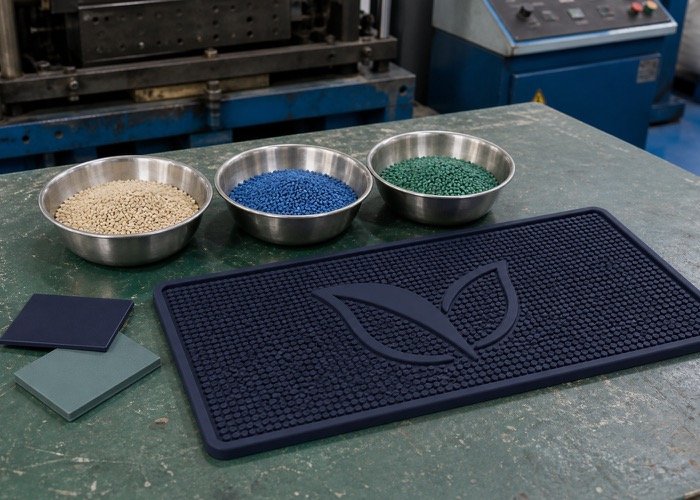
- Ask about the source: A reputable manufacturer like SuperfectCraft will be transparent about the materials used. We prioritize virgin materials that are stable, durable, and free from harsh odors.
- Request a sample: Before placing a large order, get a sample to check for any unpleasant smells and to test its texture and durability.
Mistake 2: Confusing PVC with Rubber
To the untrained eye, a PVC mat can look similar to a rubber one, but their performance couldn't be more different. PVC is a harder, less flexible plastic. While it might be fine for a decorative mat at home, it’s a disaster in a commercial bar.
The biggest issue is a lack of grip. When a PVC bar mat gets wet with beer, juice, or soda, its surface becomes extremely slick. This creates a high risk of glasses tipping over, leading to breakage and spills. En outre, PVC is not resistant to alcohol[^2]. Over a short period, ça va devenir cassant, crack, or develop a sticky surface.
Rubber is the only suitable choice for a functional commercial bar environment. Its natural tackiness provides excellent grip even when wet[^3], keeping your glasses securely in place.
Here’s a quick comparison:
| Fonctionnalité | Tapis de bar en PVC | Tapis de barre en caoutchouc | Tapis de barre en silicone |
|---|---|---|---|
| Wet Grip | Poor / Slippery | Excellent | Very Good |
| Durabilité | Faible (cracks easily) | Haut | Very High |
| Alcohol Resistance | Poor | Bien | Excellent |
| Résistance à la chaleur | Faible | Moderate | Haut (Ideal for coffee bars) |
| Sentir | Hard / Stiff | Doux / Flexible | Very Soft / Flexible |
| Best Use Case | Home decoration only | Commercial bars, workshops | Coffee bars, medical, food prep |
Mistake 3: Selecting Silicone That's Too Thin
Silicone is a fantastic material—it's highly durable, résistant à la chaleur, and non-toxic. Cependant, its effectiveness is directly tied to its thickness. Buyers trying to cut costs might opt for a very thin silicone mat, perhaps only 1-2mm thick.
This is a critical error. A thin silicone mat lacks the structural integrity to support heavy items. When you place a full beer pitcher, a heavy cocktail shaker, or a portafilter on it, the mat will sag and collapse. This defeats the purpose of a drainage mat, as liquid will simply pool in the sunken area instead of flowing away.
For any professional application, un bar mat should have a substantial thickness.
- Commercial Standard: We recommend a thickness of 3mm to 6mm for most bar and coffee shop applications.
- Heavy-Duty Use: For industrial settings or areas with very heavy tools, a thickness of up to 10mm might be necessary.
A thicker mat provides the rigidity needed to keep the drainage channels open and functional, ensuring your work surface stays dry and clean.
Is Your Bar Mat Sizing and Specification All Wrong?
You've chosen the right material, but your work isn't done. The physical dimensions and design features of the bar mat are just as important for functionality. A mat that is the wrong size or has a poor design will create daily frustrations for your team.
Many buyers make this mistake by simply looking at product photos and guessing what will fit. This approach almost never works. Taking a few moments to measure and consider the specific design features will save you a major headache later on.
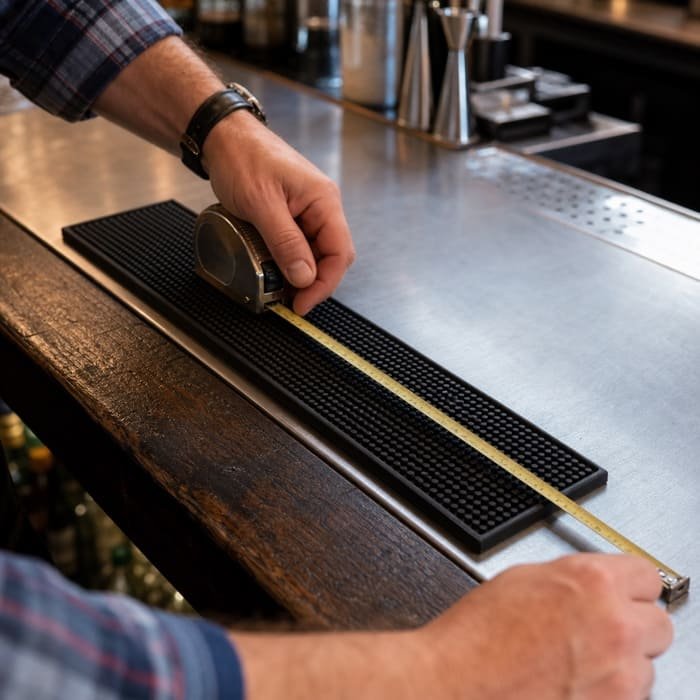
Mistake 4: Not Measuring Your Bar Counter
It sounds obvious, but it happens all the time. A buyer orders a standard-sized bar mat without measuring their actual workspace.
- If it's too small: It won't cover the main service area, leaving your beautiful wood or stone countertop exposed to spills, taches, and scratches.
- If it's too big: It will hang over the edge of the counter. This not only looks sloppy but also creates a snag hazard. The overhanging edge will constantly get bumped, causing the mat to lift, curl, and wear out prematurely.
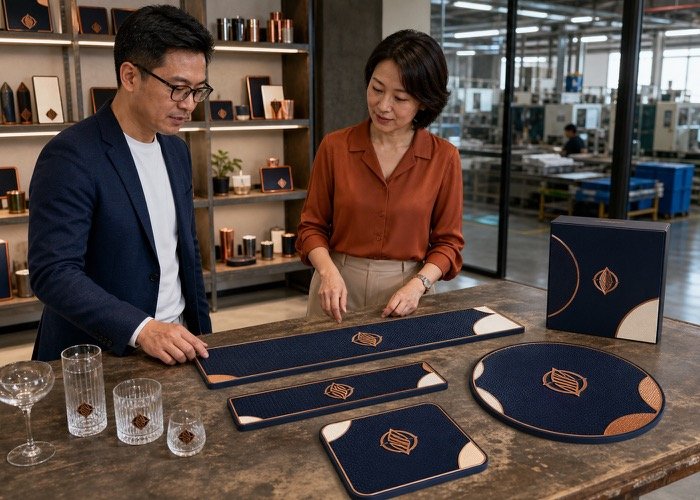
How to avoid this: Use a tape measure to get the precise length and width of the area you want to cover. Then, subtract 2-3cm (about 1 inch) from both dimensions. This small buffer ensures the mat lays perfectly flat and is protected by the counter edge, giving you a clean, professional fit. Chez SuperfectCraft, we specialize in creating mats to your exact custom dimensions, ensuring a perfect fit every time.
Mistake 5: Ignoring the Drainage Groove Depth and Design
Not all drainage patterns are created equal. The purpose of the nubs and grooves on a bar mat is to elevate glassware and channel away spilled liquid, keeping the glass base dry. Many first-time buyers overlook the depth and pattern of these grooves.
A mat with very shallow grooves (less than 2mm deep) cannot handle a significant spill. Liquid quickly fills the channels and pools up, leaving your glasses to sit in a puddle. This leads to unsightly watermarks on the glass and a generally messy-looking bar.
What to look for:
- Groove Depth: For a commercial bar, select a mat with a groove depth of at least 3-4mm. This provides enough volume to contain spills and promote airflow for drying.
- Channel Pattern: Look for a mat with a dense network of intersecting channels. This design efficiently directs liquid away from the glass, no matter where it's placed on the mat.
- Border Design: Consider the edge of the mat. A mat with no raised border allows liquid to flow right off the sides and onto your floor. A slightly raised, integrated border contains spills effectively. Cependant, an overly tall, bulky border can be difficult to clean and store. A low-profile, one-piece molded border is often the best choice.
Are You Making These Custom Bar Mat Printing Errors?
For many businesses, un bar mat is more than a utility item—it's a piece of branding. If you are ordering custom mats with your logo, the printing process is where many costly mistakes are made. These errors can turn a beautiful branding opportunity into a blurry, fading disappointment.
This section is especially critical for procurement managers, brand owners, and importers ordering OEM/ODM products. Getting the customization details right is key to receiving a product that reflects your brand's quality standards.
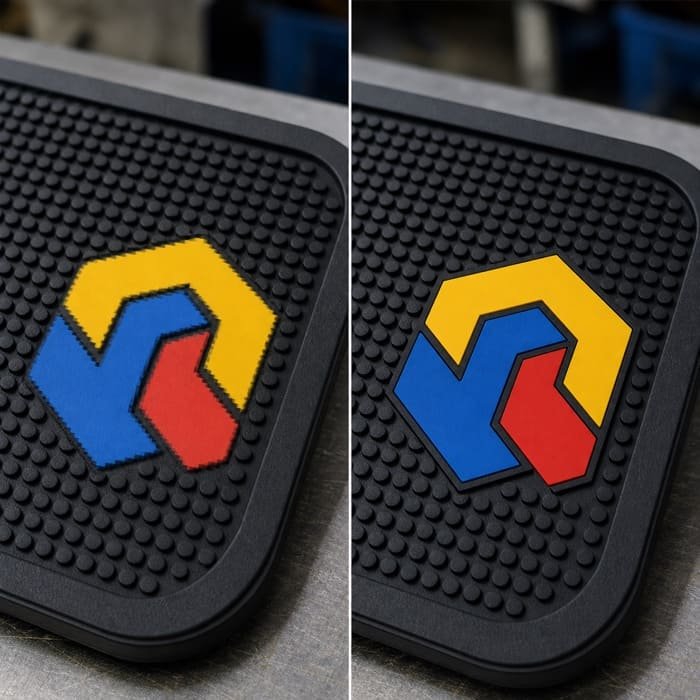
Mistake 6: Choosing the Wrong Logo Printing Method
To save money, a factory might offer a low-cost surface screen printing option. While the initial result might look okay, this method is not durable enough for a bar environment. The ink sits on the surface of the rubber. With constant wiping, cleaning chemicals, and alcohol exposure, the logo will quickly begin to flake, rub off, and fade.
A branded bar mat with a worn-out logo looks terrible and reflects poorly on your business.
How to avoid this: For any commercial application, you must choose a more durable printing method.
- Embedded / Debossed Color-Fill: This is the gold standard. Your logo is molded (gravé) into the mat, and then liquid PVC or silicone in your brand colors is poured into the recess. The logo becomes an integral part of the mat and can never wear off.
- Heat Transfer (Sublimation): This process uses heat and pressure to infuse the ink into the material itself, rather than just sitting on top. This is a great option for complex, multi-color graphics and is also highly durable.
Mistake 7: Providing Low-Resolution Artwork
This is a huge one. A customer sends their logo to the factory as a low-resolution file, like a screenshot from their phone or a small JPEG from their website. The factory, wanting to proceed with the order, uses this file for production.
The result is a disaster. The final printed logo on the bar mat is blurry, pixelated, and has jagged, unprofessional-looking edges. No matter how high-quality the mat material is, a poorly printed logo will make the entire product look cheap.
How to avoid this:
- Always provide vector artwork. Vector files (formats like .IA, .PSE, or .PDF) are built with mathematical equations, not pixels. This means they can be scaled to any size—from a business card to a billboard—without losing any quality.
- If you don't have a vector file: Don't worry. A good manufacturing partner can help. Chez SuperfectCraft, we offer a 24-hour design sketch service where we can take your existing image and professionally recreate it as a high-quality vector file for your approval, gratuitement.
Mistake 8: Not Confirming Physical Color Samples
Colors look dramatically different on a backlit computer screen (which uses an RGB color model) compared to a physical object (which uses a CMYK or Pantone color model).[^4] Approving your brand colors based solely on a digital proof is a recipe for disappointment. That "perfect brand blue" on your monitor can easily turn into a dull, grayish-blue on the final rubber product.
I've seen clients have to reject entire shipments because the color of the mat didn't match their brand guidelines, all because they skipped this crucial step.
How to avoid this:
- Provide Pantone (SPM) codes couleurs: If you have them, these codes provide a universal standard for color matching.
- Request a pre-production sample: The single best way to ensure color accuracy is to have the factory produce one finished sample for your approval before starting mass production.
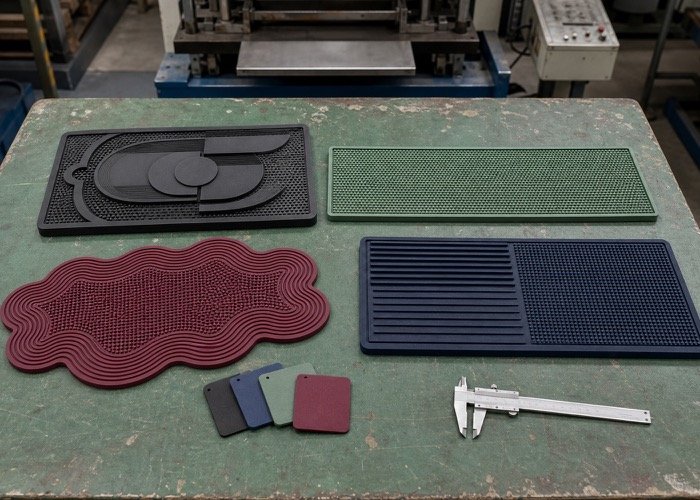
- Request a physical color swatch: As a faster alternative, ask the factory to mix the rubber or PVC to your specified color and send you a small, cured swatch of the material. This allows you to see the exact color and texture in person.
Does Your Bar Mat Actually Fit Your Use Case?
The final category of mistakes involves a fundamental mismatch between the product's features and the environment where it will be used. UN bar mat is a specialized tool, and using the wrong tool for the job will lead to failure.
You wouldn't use a screwdriver to hammer a nail. Similarly, you shouldn't use a thin, decorative mat in a high-volume nightclub, or a standard rubber mat on a hot coffee station. Thinking through your specific operational needs is the final step to a successful purchase.
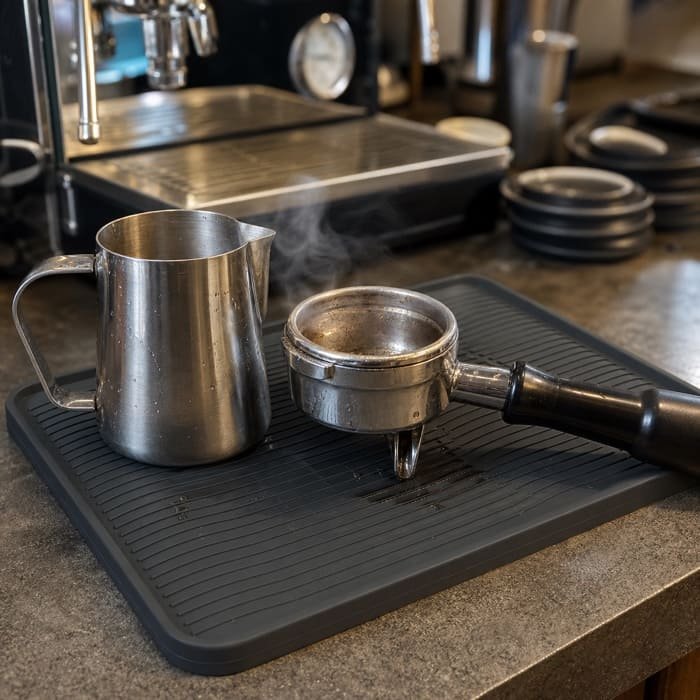
Mistake 9: Forgetting Key Performance Features
Beyond the basics, different environments demand specific performance characteristics. Overlooking these can lead to rapid product failure.
- Alcohol & Chemical Resistance: Are you serving spirits or craft cocktails? Standard rubber can degrade, discolor, or become sticky when exposed to high-proof alcohol or acidic citrus juice. For a busy bar, you need a bar mat made with a solvent-resistant formula that can withstand chemical exposure without breaking down. The same applies to coffee shops, where acidic espresso can corrode inferior materials.
- Anti-Slip Backing: Your countertop material matters. A polished granite, marble, or stainless steel surface is very slick. A mat with a smooth bottom will slide around dangerously every time a bartender leans on it. Always check that the mat has a textured or grid-patterned base to provide essential grip and keep it firmly in place.
- Résistance à la chaleur: This is a non-negotiable for coffee shops. Placing a hot portafilter, steam wand, or coffee pot directly onto a standard PVC or rubber mat will cause it to melt, bubble, or warp instantly. For any application involving high heat, you must choose a heat-resistant silicone bar mat, which can typically handle temperatures up to 230°C (446°F)[^5].
Mistake 10: Mismatching the Mat Design to the Venue Type
The type of establishment you run dictates the ideal design of your mat.
- For High-Volume Bars & Nightclubs: These venues experience heavy use and massive spills. Using a thin, residential-style mat is a huge mistake. It will quickly become saturated, allowing liquid to seep underneath and promote mold and mildew growth on your counter. These venues require a thick, high-density rubber bar mat with deep drainage channels to handle the volume.
- For Cafes, Smoothie & Juice Bars: These businesses deal with thick, sugary syrups, fruit pulp, and dairy. UN bar mat with very deep, wide grooves can be a nightmare to clean, as this sticky residue gets trapped in the crevices. For these environments, it's better to choose a mat with a shallower, denser pattern of grooves. This design still provides drainage but is much easier to rinse and wipe clean.
- For Outdoor Patios & Tiki Bars: A standard rubber mat will not survive long when exposed to the elements. The sun's UV rays will cause the material to become brittle, crack, and fade within a couple of months.[^6] For any outdoor application, you must specify a material with a UV-resistant and anti-aging formula to ensure longevity.
Foire aux questions
What's the real difference between a PVC and a rubber bar mat?
The main differences are grip and durability. Rubber offers excellent grip even when wet, making it safe for commercial bars. PVC becomes very slippery. Rubber is also far more durable and resistant to alcohol, whereas PVC tends to crack and become sticky over time.
How thick should a commercial bar mat be?
For most commercial bars, restaurants, and coffee shops, a thickness between 3mm and 6mm is ideal. This provides the necessary sturdiness to support heavy items and ensure drainage channels remain open and functional, preventing liquid from pooling.
What file format do I need for a custom logo bar mat?
You should always provide your logo as a vector file to ensure a sharp, clear print. The most common vector formats are Adobe Illustrator (.IA), PostScript encapsulé (.PSE), or a vector-based PDF. This prevents your logo from looking blurry or pixelated on the final product.
Quelle est la quantité minimum de commande (MOQ) for custom bar mats?
MOQ varies by manufacturer and customization complexity. Chez SuperfectCraft, our standard MOQ is 200 pièces par design et couleur, especially when using our large library of existing molds. It's always crucial to confirm the MOQ with your supplier before committing to a custom design.
Conclusion
Choosing the right bar mat is an investment in your business's safety, efficiency, and brand image. By avoiding these ten common mistakes, you can move past the cheap, disposable options and source a product that truly performs. Remember to prioritize the right material (usually rubber or silicone), take precise measurements, demand durable printing methods, and match the mat’s features to your specific venue. A high-quality bar mat not only keeps your service area clean and safe but also serves as a constant, durable advertisement for your brand.
Ready to design a custom bar mat that is built to last and perfectly represents your business? Contact the experts at SuperfectCraft. We offer OEM/ODM production with free design sketches, a huge library of existing molds, and expert guidance on material and feature selection.
Reach out today to start your project:
- WhatsApp: +86 15816822766
- E-mail: sales01@superfectcraft.com
[^1]: "Mass flow analysis of tire-wear particles, including carbon black, ...", https://www.sciencedirect.com/science/article/abs/pii/S1352231025001591. Research on rubber abrasion and tire-wear particles shows that wear of carbon‑black–reinforced elastomers produces black particulate debris, consistent with the appearance of fine black residue when rubber surfaces degrade under friction. Rôle de la preuve: mécanisme; type de source: research. Prise en charge: Abrasion of carbon-black–filled rubber generates black particulate debris.. Note sur la portée: Wear rates and residue appearance depend on rubber formulation, surface texture, and use conditions; bar mats may experience different abrasion than tires. [^2]: "Polyvinyl chloride", https://en.wikipedia.org/wiki/Polyvinyl_chloride. Reference material on polyvinyl chloride notes that exposure to organic solvents can extract plasticizers and alter PVC’s mechanical behavior, supporting concerns about reduced durability and tackiness under alcohol exposure. Rôle de la preuve: support_général; type de source: encyclopédie. Prise en charge: PVC’s resistance to organic solvents like ethanol is limited, with risks of plasticizer extraction affecting mechanical properties.. Note sur la portée: Resistance varies by PVC formulation and plasticizer type, and service conditions (temperature, concentration, duration) influence outcomes. [^3]: "Rubber friction on wet and dry road surfaces: The sealing effect", https://link.aps.org/doi/10.1103/PhysRevB.71.035428. Tribology research on rubber friction describes how viscoelastic hysteresis and micro-roughness interactions sustain relatively high friction compared to smooth plastics, providing a mechanistic basis for the claim of better wet grip. Rôle de la preuve: mécanisme; type de source: research. Prise en charge: Rubber’s viscoelastic hysteresis and surface interactions contribute to high friction, including in wet conditions on rough substrates.. Note sur la portée: Performance depends on rubber compound, surface roughness, and the nature of the liquid film; lisse, contaminated surfaces can still reduce rubber traction. [^4]: "RGB vs CMYK: What's the Difference?", https://www.vistaprint.com/hub/correct-file-formats-rgb-and-cmyk?srsltid=AfmBOooFSrqPzcWQ7n7wByMdlW6loTLwUTOWEmVeCy2nxn8hrCjpzNQd. References on color models and the Pantone system explain that RGB and CMYK have differing gamuts and that standardized spot colors differ from on‑screen display, supporting the need for physical samples to verify final color. Rôle de la preuve: support_général; type de source: encyclopédie. Prise en charge: RGB and CMYK use different color gamuts and reproduction methods, and Pantone is a standardized ink system, leading to screen‑to‑print differences.. Note sur la portée: Accurate color management and device profiling can mitigate discrepancies, though not eliminate gamut limitations. [^5]: "Silicone rubber", https://en.wikipedia.org/wiki/Silicone_rubber. Materials references describe silicone rubber’s thermal stability and report continuous-use temperature ranges that can extend to approximately 200–230°C for specific formulations, consistent with the stated capability. Rôle de la preuve: support_général; type de source: encyclopédie. Prise en charge: Silicone rubber is known for high temperature stability, with some grades rated for continuous use near 200–230°C.. Note sur la portée: Temperature tolerance depends on the exact silicone formulation and whether exposure is continuous or intermittent. [^6]: "Research Progress on Fatigue Life of Rubber Materials - PMC - NIH", https://pmc.ncbi.nlm.nih.gov/articles/PMC9654122/. Materials degradation studies document that rubber exposed to sunlight and atmospheric oxidants undergoes photodegradation and ozone-related cracking, supporting the described outdoor failures. Rôle de la preuve: mécanisme; type de source: research. Prise en charge: UV and oxidative weathering cause polymer chain scission and surface damage in rubbers, leading to embrittlement, cracking, and fading.. Note sur la portée: Degradation rates depend on rubber type, stabilizers, pigmentation, and exposure conditions; the timeframe can vary substantially.