
Struggling to find a genuine factory for your custom bar mats? You're likely dealing with trading companies that add costs and complexity without adding value. This leads to frustrating communication gaps, missed deadlines, and a lack of control over your product’s quality. The solution is to learn how to identify, verify, and partner directly with the original manufacturer of a bar mat from the start.
To find the original manufacturer of a bar mat, you must select the right industrial region based on your order size, conduct surprise video factory tours to verify production lines and mold workshops, ask deep technical questions about the PVC drip molding process, and run a small trial order to test quality and reliability before signing a long-term OEM contract.
Simply finding a supplier online isn't enough. The difference between a profitable, high-quality product line and a sourcing nightmare lies in your ability to vet your partners effectively. Let's walk through the exact six-step process I use to separate the real factories from the fakes, ensuring a stable and successful supply chain.
How Do You Select the Right Industrial Region for Your Bar Mat Order?
Sourcing from a country as vast as China can feel overwhelming, and choosing the wrong location is a common first mistake. You might end up in a region known for trading, not manufacturing, or talking to factories that aren't equipped for your order volume. Understanding China's specialized industrial clusters is your first strategic advantage.
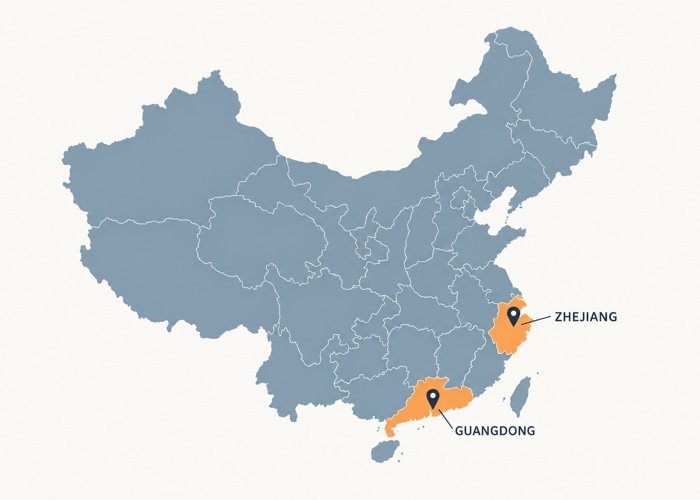
For sourcing bar mats, you should select your industrial region based on order volume. For large-scale foreign trade orders that demand robust supply chains and high capacity, focus on Dongguan and Foshan. For smaller, more flexible batches and private-label startups, consider Wenzhou and Taizhou.
Dongguan and Foshan: The Powerhouses for Large Orders
The Pearl River Delta, which includes cities like Dongguan and Foshan, is the world's factory floor for a reason. This region is optimized for large-scale, export-oriented manufacturing. As a manufacturer based in Dongguan, we benefit directly from this ecosystem.
The advantages here are immense:
- Mature Supply Chains: We have immediate access to high-grade raw materials like PVC plastisol, silicone, and rubber at competitive prices. This vertical integration reduces delays and ensures material consistency.
- Skilled Labor: The workforce here is highly experienced in complex processes like PVC drip molding, ensuring that intricate logos and designs are executed perfectly.
- Logistical Hub: Proximity to major ports in Shenzhen and Guangzhou means faster and cheaper shipping for international clients.
If you are a beverage brand, a large distributor, or a private-label company planning an order of 1,000 units or more, this is the region to focus your search on. The infrastructure is built to handle volume, complexity, and stringent quality requirements.
Wenzhou and Taizhou: The Hubs for Small-Batch Flexibility[^1]
En revanche, cities in Zhejiang province like Wenzhou and Taizhou are famous for their vibrant ecosystem of small-to-medium enterprises (SMEs). These factories are known for their agility and willingness to accept smaller order quantities.
This region is ideal if you are:
- A startup testing a new product.
- An online brand needing a low initial inventory.
- A business requiring a very fast turnaround on a small batch.
The trade-off is that the supply chain may not be as deeply integrated as in the Pearl River Delta. Cependant, their flexibility and lower MOQs make them an excellent choice for market entry.
Comparing Manufacturing Regions
| Fonctionnalité | Dongguan / Foshan (Pearl River Delta) | Wenzhou / Taizhou (Zhejiang) |
|---|---|---|
| Idéal pour | Large OEM/ODM orders (>1,000 pièces) | Small batches, startups (<500 pièces) |
| Strengths | Mature supply chain, high capacity, export logistics | Agility, lower MOQs, rapid response |
| Primary Focus | Established brands, international importers | Domestic market, emerging online brands |
| Notre emplacement | Dongguan, leveraging the robust infrastructure | N/A |
What's the Best Way to Verify a Supplier is an Original Manufacturer of a Bar Mat?
Every online profile claims "we are a factory," but many are just trading offices with a small showroom. You could waste weeks negotiating with a middleman who simply forwards your emails while adding their own margin. A surprise video tour is the single most powerful tool to cut through the noise.
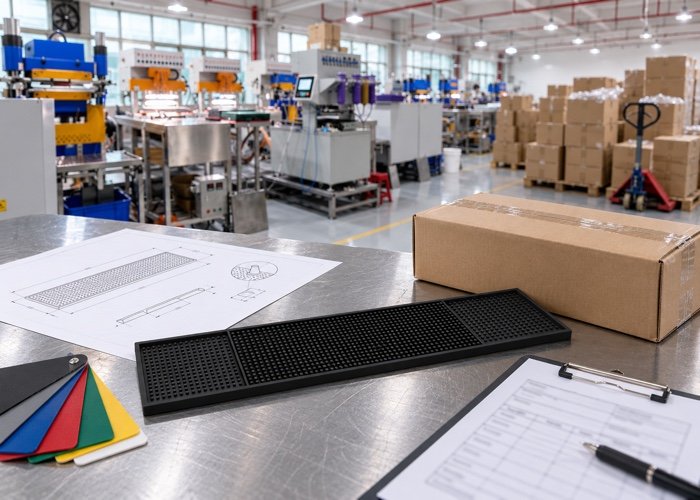
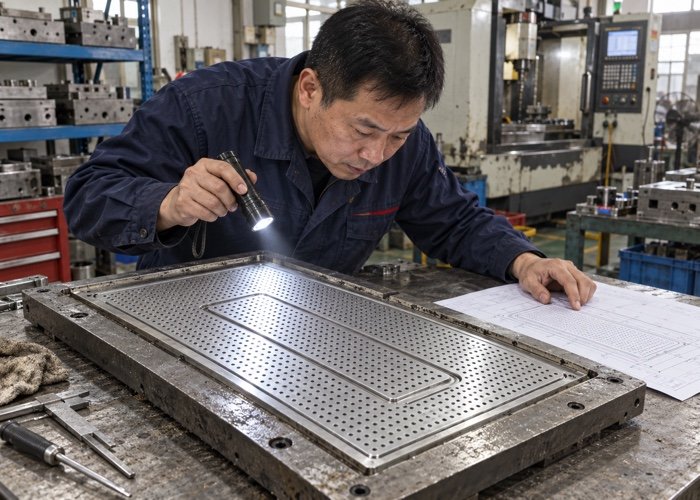
The most effective way to verify a supplier is a surprise live video factory tour. During the call, ask to see four non-negotiable areas: le mold workshop, le complete production line in operation, le raw material warehouse, and their quality control station. A real factory will be able to show you these immediately. A trader cannot.
The "surprise" element is critical. Don't pre-schedule a "factory tour" days in advance, which gives a trading company time to visit a partner factory and pretend it's theirs. Instead, during a regular video call, simply say, "Great, could you walk me over to the production line now? I'd love to see it."
The Four Critical Areas to Inspect on a Video Tour
-
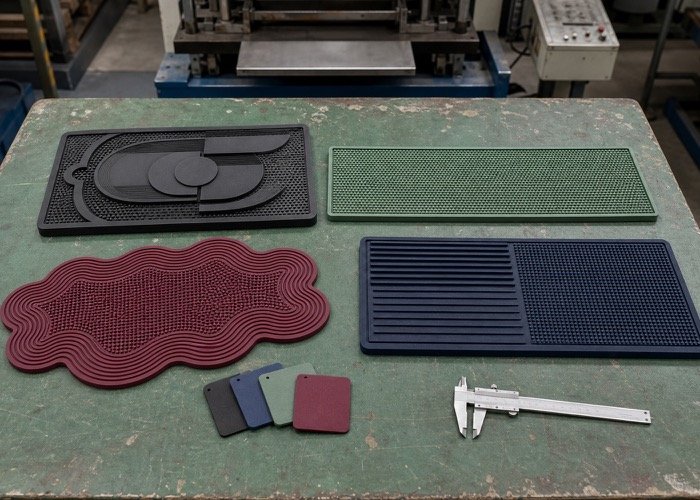
The Mold Workshop: This is the heart and soul of a true OEM/ODM original manufacturer of a bar mat. A factory that makes custom products must also make custom molds. Ask to see their CNC machines, molds being polished or finished, and their library of existing molds. A trader will never have a mold workshop. Chez SuperfectCraft, our extensive library of existing molds is a key asset we proudly show clients, as it can significantly speed up development time.
-
The Complete Production Line: You need to see the process from start to finish. For a PVC bar mat, this includes:
- Color mixing and dispensing stations.
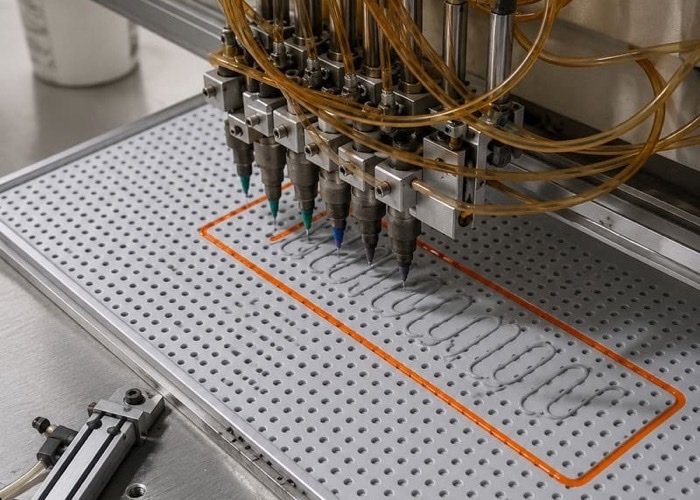
- Automated or manual dispensing machines injecting liquid PVC into molds.
- The curing ovens.
- The demolding, trimming, and cleaning area. Ask them to show you a product that is currently being manufactured on the line.
-
The Raw Material Warehouse: A real factory buys materials in bulk. Look for large drums of liquid PVC, sacks of rubber or silicone, and barrels of color pigments. A trader's "warehouse" is typically a small room filled with finished goods they bought from other factories. A large, organized stock of raw materials is a clear sign of a genuine manufacturer.
-
Contrôle de qualité (QC) Station / Lab: While not every factory has a multi-million dollar laboratory, every legitimate one has a designated area for quality control. Ask to see where they check finished products for dimensional accuracy, color correctness against Pantone standards, and physical defects. This demonstrates a commitment to quality that goes beyond just production.
How Can You Differentiate a Trader from an Original Manufacturer of a Bar Mat with Questions?
Even if a supplier passes the video tour, their sales representative might still be a smooth-talker from a trading company. If you can't get clear answers to deep technical questions, you risk production problems later because the person you're communicating with can't actually solve them. Asking specific questions about the manufacturing process is a powerful litmus test.
To test their expertise, ask detailed questions about the PVC drip molding (滴塑) processus. Inquire about challenges like preventing color bleeding in complex logos, the curing temperatures for different thicknesses, and how they formulate PVC to achieve a specific flexibility or hardness. A trader's knowledge is shallow; a real manufacturer's is deep.
A salesperson from a trading company can talk about price, MOQ, and lead time. An engineer or an experienced sales representative from a real factory can talk about processus.
Key Technical Questions That Expose a Middleman
Try asking these questions on your next call. The difference in answers will be night and day.
-
"For a logo with fine lines and adjacent colors, how do you prevent the PVC from bleeding during the baking process?"
- Good Answer (Manufacturer): "We engineer fine dams into the mold itself to create a physical barrier. We also carefully control the viscosity of the liquid PVC and sometimes use a multi-stage baking process, partially curing one color before dispensing the next to ensure sharp lines."
- Bad Answer (Trader): "Don't worry, our factory is very experienced and handles this."
-
"What is the standard Shore A hardness for your bar mats, and how would you adjust the formulation to make the mat more flexible?"
- Good Answer (Manufacturer): "Our standard is around Shore A 75-80, which offers a good balance of durability and flexibility. To make it more flexible, we would increase the ratio of plasticizer (like DOTP) to PVC resin in the plastisol formulation before production."
- Bad Answer (Trader): "We can make it soft or hard, just let us know what you want."
-
"Can you explain your Pantone color-matching process? What happens if my brand's color is difficult to achieve in PVC?"
- Good Answer (Manufacturer): "We use a spectrometer to create a lab dip, or a small physical color sample, for your approval before mass production. Some fluorescent or metallic Pantones are challenging. If a perfect match isn't possible, we will show you the closest achievable option and get your sign-off."
- Bad Answer (Trader): "Yes, we can match any Pantone color."
Why Are Samples and Trial Orders Crucial Before Committing?
You've found a factory, the tour was impressive, and they answered your technical questions perfectly. You're ready to place a 10,000-unit order. But hold on. What if the quality of the mass-produced units doesn't match the "golden sample" they sent you? What if their promised 20-day lead time stretches to 45 days on a real order? A multi-stage validation process is the only way to mitigate this risk.
Uniform sample testing allows you to physically assess quality from multiple potential suppliers. A subsequent small trial order (par ex., 200–500 units) is the ultimate test of their consistency in quality control, adherence to lead times, and post-sale support before you commit to a large-scale OEM contract.
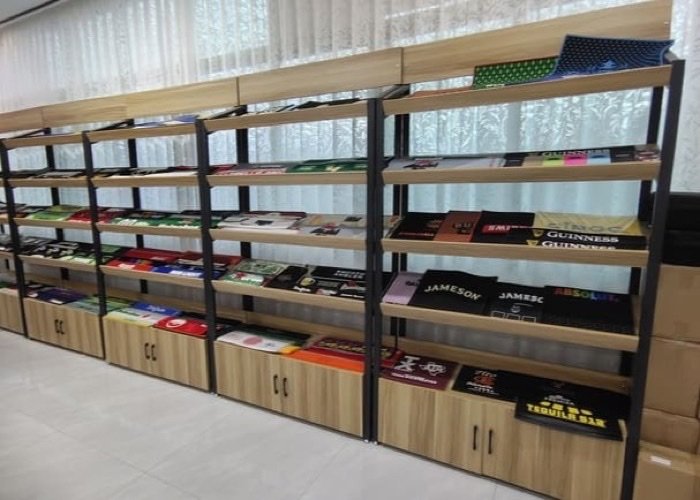
This two-stage process proves they can not only make one perfect item but can also replicate that quality reliably at scale.
Scène 1: Standardized Sample Testing
Don't just ask potential suppliers for a random sample from their showroom. To conduct a true "apples-to-apples" comparison, give your top 2-3 factory candidates the exact same design file and specifications.
When the samples arrive, evaluate them side-by-side on these criteria:
- Color Accuracy: Hold them up to your Pantone book. Are they accurate or just "close enough"?
- Detail & Sharpness: Look at the edges of your logo. Are they crisp and well-defined, or are they blurry and bleeding? I once had a client whose decision came down to which factory could perfectly render the tiny "®" symbol next to their logo.
- Material Feel & Odor: Does the mat feel substantial or flimsy? Does it have a strong chemical smell? Quality raw materials make a noticeable difference.
- Durabilité: Bend it, flex it, and try to scratch the surface. A well-made mat will be resilient.
Scène 2: The Small-Batch Trial Order
A perfect sample proves they can do it. A successful trial order proves they can do it consistently. This is your chance to test their real-world performance before risking significant capital. Our MOQ of just 200 pieces is specifically structured to facilitate this critical de-risking step for our clients.
Use this first small order to validate:
- Délai de production: If they promised 25 jours, did they ship on day 25 or day 40?
- Quality Consistency: Randomly inspect 10-20% of the units. Is the quality identical from the first mat to the 200th?
- Communication: How did they handle the process? Were they proactive with updates? If a minor issue arose, did they inform you and offer a solution?
- Conditionnement: Did the products arrive safely and packaged according to your specifications?
If a supplier passes this trial order with flying colors, you can proceed with confidence.
What Should Be in Your OEM Contract with an Original Manufacturer of a Bar Mat?
You've done the hard work, validated your supplier, and are ready to build a long-term partnership. A verbal agreement or a simple Purchase Order is not enough. If you don't formalize the relationship with a strong contract, you leave yourself exposed to future misunderstandings about quality, intellectual property, and defect resolution.
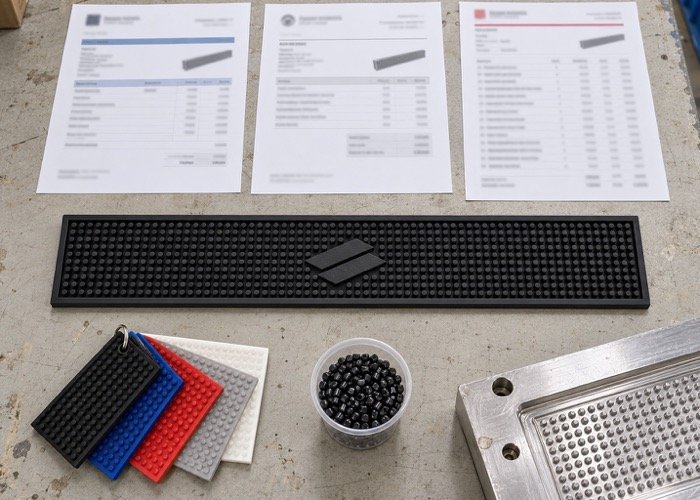
Once a supplier has passed all verification stages, you must sign a long-term OEM agreement. This contract acts as your rulebook and should clearly define material standards, mold ownership and storage policies, et specific quality compensation clauses to protect your investment.
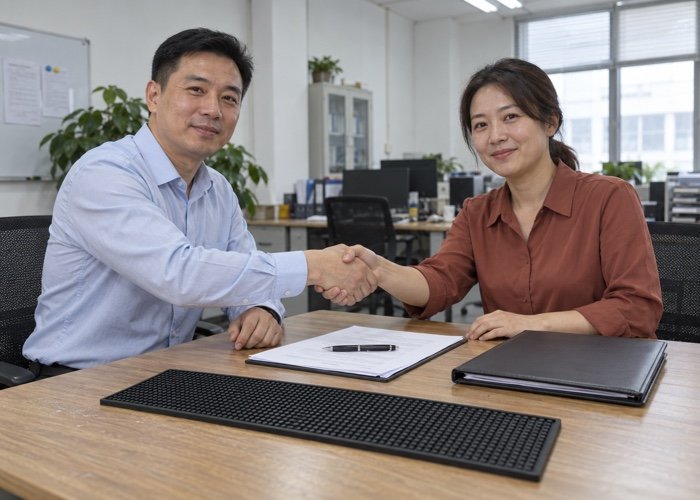
A comprehensive contract protects both you and the manufacturer by setting clear expectations from the outset.
Non-Negotiable Clauses for Your OEM Contract
-
Specific Material and Quality Standards:
- Do not accept vague terms like "high-quality PVC."
- Reference the approved physical sample: "All mass-produced units must be identical in color, dimension, weight, and material feel to approved sample #S-123, signed and dated."
- Specify any required compliance: "Material must conform to REACH (EC) Non 1907/2006 standards as verified by third-party test report #T-456."
-
Mold Ownership, Custody, and Maintenance:
- If you paid a mold fee, the contract must explicitly state that you are the sole owner of the tool.
- Include a non-use clause: "Manufacturer agrees not to use client's mold [Mold ID #M-789] for any other third-party orders."
- Define storage and maintenance terms. Chez SuperfectCraft, we offer secure, labeled storage for our clients' proprietary molds to ensure they are protected and ready for future production runs.
-
Contrôle de qualité (QC) and Compensation Clauses:
- Define the Acceptable Quality Limit (AQL), a statistical standard for inspections (par ex., AQL 2.5 for major defects, 4.0 for minor defects).
- Clearly outline the remedies for failed QC: "In the event that defects exceed the AQL, the manufacturer will, at the client's discretion, either remake the defective units at no charge or provide a credit of equivalent value on the next order."
-
Propriété intellectuelle (IP) Protection:
- Include a straightforward clause affirming that your logo, brand name, and all associated artwork are your exclusive intellectual property and cannot be used or shared without your explicit written consent.
Foire aux questions
Why is it cheaper to work with an original manufacturer of a bar mat?
Working directly with the factory cuts out middlemen like trading companies, who typically add a 10-30% margin for simply passing along your order. This direct relationship means lower unit costs, more transparent communication, and greater control over the final product quality.
What is the typical MOQ for custom bar mats?
The Minimum Order Quantity (MOQ) varies by factory. Chez SuperfectCraft, notre MOQ peut être aussi bas que 200 pièces par conception, especially if you can use one of our many existing molds. For a completely new custom mold and shape, the MOQ might be slightly higher to help offset the initial tooling investment.
How long does it take to get a sample and a mass-produced order?
Generally, a custom sample takes about 7 days to produce after the design and colors are confirmed. Once you approve the physical sample, mass production for an order typically takes between 20 et 30 jours, depending on the final quantity and the complexity of your design.
Can a factory help me if I don't have a design file?
Oui, a good OEM manufacturer should be able to assist with design. We offer a free 24-hour design sketch service for our clients. You can provide us with your logo file, dimensions souhaitées, and a general concept, and our team will create a professional, production-ready artwork for your approval.
Conclusion
Finding a true original manufacturer of a bar mat is a systematic process, not a game of chance. It requires moving beyond surface-level searches and implementing a rigorous vetting strategy. By strategically selecting the right industrial region, verifying capabilities with live video tours, testing technical expertise with targeted questions, and de-risking the partnership through samples and trial orders, you can build a resilient and profitable supply chain. Enfin, cementing the relationship with a detailed OEM contract protects your investment and sets the stage for a long-term, successful partnership. This diligent process ensures you are working with a true partner, not just another vendor.
If you're ready to partner with a verified original manufacturer that offers expert design support, transparent production, and a steadfast commitment to quality, we're here to help. Contact us at SuperfectCraft today to discuss your project and receive a free design sketch within 24 heures.
[^1]: "Zhejiang's Advantages, Challenges and Countermeasures ...", https://www.atlantis-press.com/article/125971748.pdf. Educational resources on Zhejiang province's manufacturing industry describe Wenzhou and Taizhou as regions with a high concentration of SMEs, known for their flexibility and willingness to accept smaller orders. Rôle de la preuve: support_général; type de source: éducation. Prise en charge: Wenzhou and Taizhou are ideal for small-batch manufacturing due to their agility and lower MOQs.. Note sur la portée: The source may not specifically address bar mat manufacturing but provides general insights into the region's capabilities.