
Hard to choose the right material for your custom bar mats? The options—rubber, silikon, PVC—can be overwhelming, and making the wrong choice can mean overspending or getting a product that doesn't last. You need a mat that showcases your brand perfectly without breaking the budget. For most businesses, the solution is clear: understanding the dominant advantages of PVC bar mats is the key to a successful and cost-effective purchase.
The main reason PVC is the most popular material for bar mats is its unmatched combination of low cost, extreme customization flexibility, practical physical properties, and efficient manufacturing.[^1] This unique blend makes PVC the ideal choice for brand promotions, bulk orders, and businesses looking for a low-risk, high-impact branding tool.
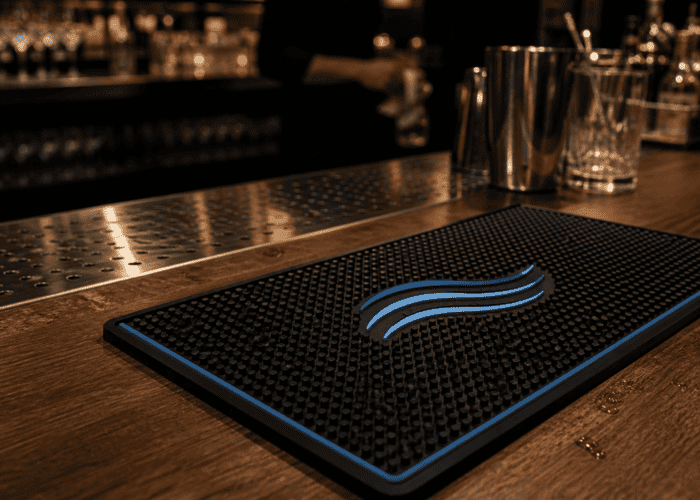
This combination of benefits isn't just a coincidence; it directly addresses the core needs of the biggest buyers, from global beverage brands to local coffee shops. But what exactly gives PVC its edge over rubber and silicone? Let's dive into the details that make it the industry's go-to material.
How Do PVC Bar Mats Offer a Superior Cost Advantage?
Are you worried that custom branding will be too expensive for your budget? High mold fees and steep minimum order quantities (MOQs) from other materials can often stop a great promotional idea in its tracks.
This is where PVC truly shines. PVC bar mats are significantly more affordable due to lower raw material costs, cheaper mold production, and smaller minimum order requirements, making them accessible even for small businesses and test runs.
Deeper Dive: The Three Pillars of PVC's Cost-Effectiveness
The price advantage of PVC isn't just a small margin; it's a fundamental difference that influences purchasing decisions at every level. Let's break down why it's so much more budget-friendly.
1. Lower Raw Material and Tooling Costs
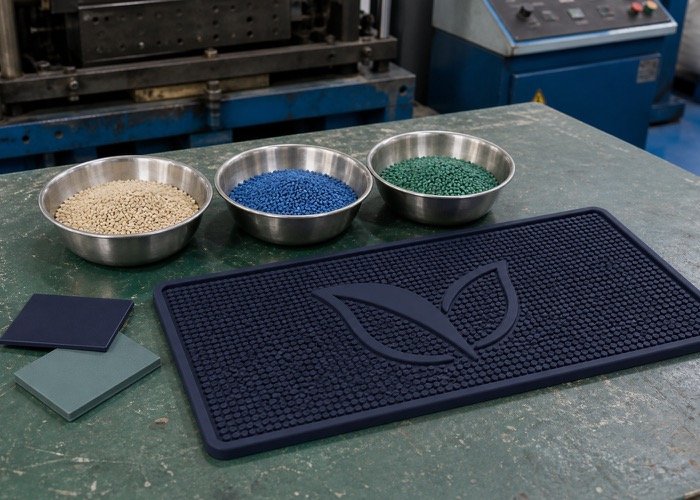
The foundation of PVC's affordability lies in its raw material. Polyvinyl chloride is a synthetic plastic polymer that is produced on a massive scale globally, making its base cost exceptionally low. In my experience, for a mat of the same size and thickness:
- A PVC bar mat typically costs only 50-70% of a comparable rubber mat.
- It costs a mere 30-50% of a food-grade silicone mat.
This cost difference extends to the manufacturing setup. The molds used for the PVC "drip molding" process are less complex and cheaper to create than the heavy-duty steel molds required for high-pressure rubber vulcanization or silicone compression molding. For a buyer, this means the initial setup fee for a new custom design is drastically lower, reducing the barrier to entry.
2. Friendly Minimum Order Quantities (MOQ)
High MOQs are a major hurdle for small businesses, startups, or companies wanting to test a new design. Rubber and silicone manufacturing processes are only efficient at scale, so factories often require orders of 500 or even 1,000 kosov.
In contrast, the PVC drip molding process is more flexible. Pri SuperfectCraftu, we can start production with an MOQ as low as 200 pieces per design if you use one of our existing molds. This flexibility is a game-changer for:
- Small businesses needing mats for a few locations.
- Marketing teams running limited-time promotions or events.
- New importers wanting to place a smaller initial order to test the market.
3. Reduced Logistics and Shipping Costs
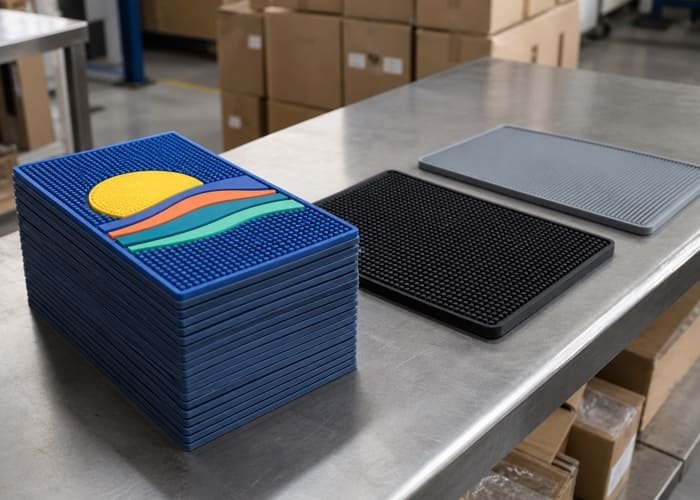
The final landed cost of a product includes shipping, and here too, PVC has an advantage. It has a moderate density and hardness, allowing mats to be stacked flat and packed tightly into cartons. They don't stick together and don't need to be rolled individually, which maximizes container space. Guma, na drugi strani, is heavier and can sometimes stick together if stacked for long periods, often requiring more bulky packaging. This efficient packing means the per-unit shipping cost for PVC bar mats is often lower.
| Funkcija | PVC palica Mat | Gumijasta palica | Silikonska palična podloga |
|---|---|---|---|
| Relative Material Cost | Nizka (30-70% less) | Medium | visoko |
| Mold/Tooling Fee | Nizka | visoko | visoko |
| Typical MOQ | 100–200 pcs | 500–1000 pcs | 500–1000 pcs |
| Packing Efficiency | visoko (Stackable) | Medium (Can stick) | Medium (Prilagodljiv) |
Why Are PVC Bar Mats the Best for Custom Branding?
Does your brand have a complex logo with intricate details or specific brand colors? You might be worried that the final product won't capture your brand's identity accurately, resulting in a poor representation on the bar counter.
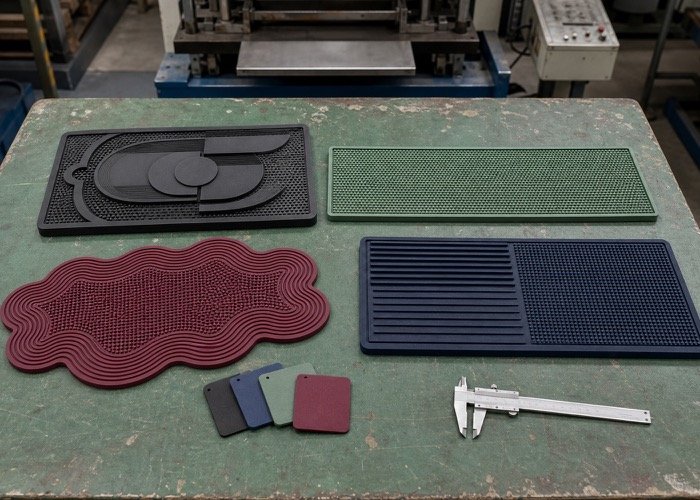
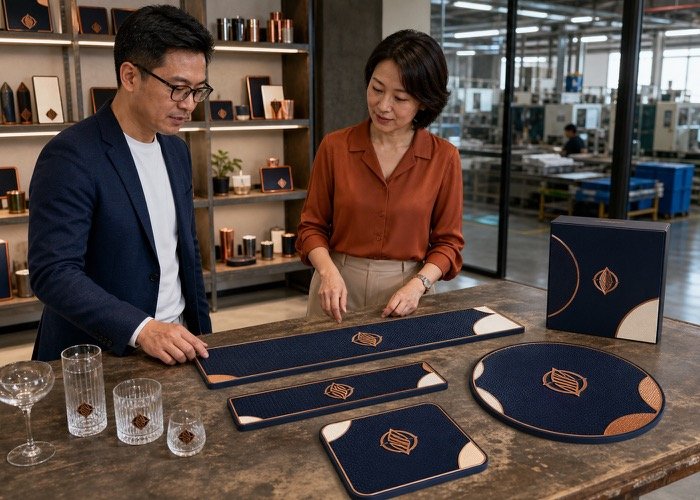
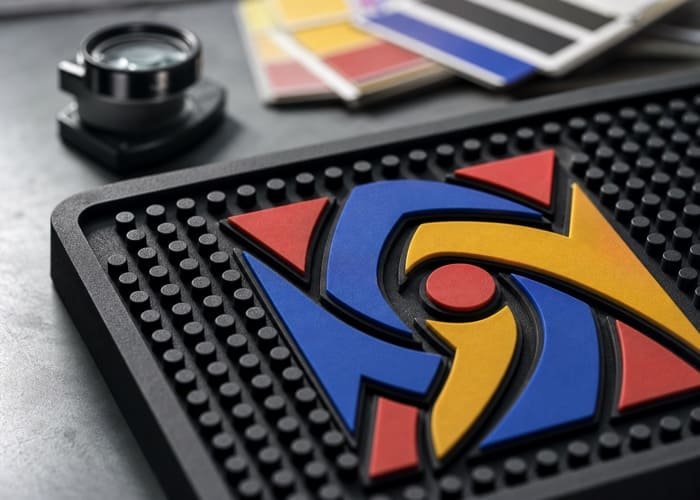
PVC resolves this by offering unparalleled design freedom. It supports a vast array of manufacturing techniques, including 3D embossing, multi-color layering, and precise color matching, ensuring your logo and brand aesthetic are reproduced with stunning clarity and depth.
Deeper Dive: Unleashing Creative Potential with PVC
For beverage companies, promotional product agencies, and brand-conscious businesses, a bar mat is a miniature billboard. Its visual appeal is non-negotiable. PVC's chemical and physical properties make it the perfect canvas for almost any design concept.
1. Unmatched Versatility in Design and Texture
Unlike rubber, which can have "blurry" edges on complex embossed designs, PVC excels at creating sharp, well-defined 3D logos. The liquid PVC is precisely dispensed by machines into a mold, plast za plastjo, allowing for intricate, multi-level designs that literally stand out. The main techniques include:
- 3D Embossing/Debossing: Creating raised or recessed logos with a tactile feel.
- Layered Color Dispensing: Injecting different colors side-by-side without them bleeding into each other. I've seen designs with over a dozen distinct colors executed flawlessly.
- Screen Printing: For highly detailed, flat graphics on the mat's surface.
This multi-technique capability means we can replicate virtually any logo, no matter how complex.
2. Total Freedom in Color and Finish
Getting brand colors right is critical. PVC can be formulated to match any Pantone color with a high degree of accuracy[^2], minimizing color variance between production batches. Nadalje, you're not limited to just solid colors. We can produce PVC bar mats in a variety of finishes to match your brand's style:
- Solid/Opaque Colors
- Translucent or "Jelly" Colors
- Fluorescent/Neon Colors
- Matte or Frosted Finishes
This level of color control is more difficult and costly to achieve with rubber and silicone, which have a more limited standard palette.
3. Precision in Custom Shapes and Cutting
Want a bar mat shaped like your bottle, logotip, or a unique design? PVC is the ideal material. After the mat is molded, it can be die-cut into virtually any custom shape with clean, smooth edges. The material is rigid enough to hold its form without fraying or tearing. Attempting to cut rubber can result in rough edges, while thin silicone can be prone to stretching and deforming during the cutting process. This makes PVC the undisputed champion for creating truly bespoke, eye-catching shapes.
What Makes the Physical Properties of PVC Ideal for Bar Environments?
A busy bar is a chaotic environment filled with spills, moisture, and sticky syrups. The last thing your staff needs is a mat that absorbs messes, develops a foul odor, or is difficult to clean at the end of a long shift.
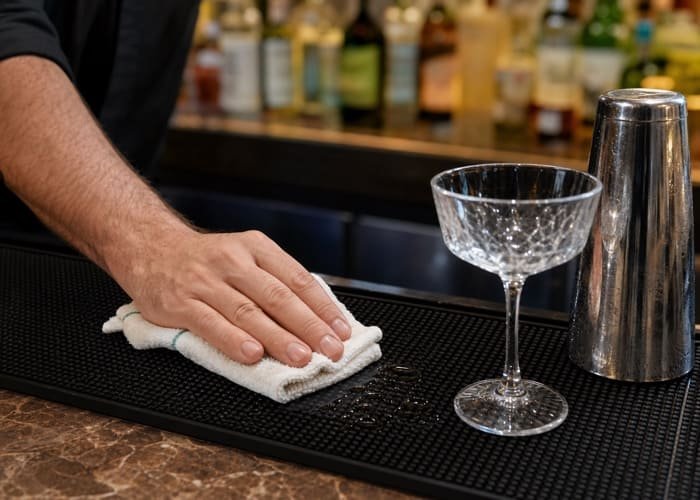
PVC is perfectly suited for this challenge. Its non-porous surface is completely waterproof, meaning it won't absorb spills, madeži, or smells. It's also highly resistant to common cleaning agents and can be wiped clean in seconds.
Deeper Dive: Built for the Realities of Service
A bar mat's primary function, beyond branding, is to manage spills and provide a stable work surface. The physical makeup of PVC is almost perfectly engineered for this demanding commercial setting.
1. Completely Non-Absorbent and Hygienic
PVC is a dense, closed-cell plastic. Unlike fabric mats that soak up liquid and become breeding grounds for mold and mildew, or porous rubber that can absorb liquids and develop a sour, sticky film over time, PVC is impermeable. Pivo, coffee, soda, and sugary syrups sit on the surface until they are wiped away. This means:
- No Staining: Coffee and wine won't seep in and leave permanent marks.
- No Odors: Spilled beer won't lead to a lingering sour smell.
- No Mildew: The mat will not rot or develop mold, even in a constantly damp environment.
2. Excellent Chemical Resistance
Bar counters are cleaned with a variety of chemicals, from sanitizers to bleach solutions. Staff might also use alcohol for cleaning. A PVC bar mat is resilient against short-term exposure to these substances. It won't become sticky, discolored, or brittle when exposed to common juices, carbonated drinks, or cleaning agents. In contrast, some lower-grade recycled rubbers can degrade and become oily when exposed to high-proof spirits.
3. Effortless Maintenance and Storage
For busy bar staff, time is money. Cleaning a PVC mat takes seconds. A quick rinse under the tap or a wipe with a damp cloth is all it takes. There's no need for special soaps or lengthy drying times. At closing time, the mats can be stacked on top of each other without any risk of them sticking together, which is a common complaint I hear from users of old rubber mats.
4. Adjustable Hardness for Different Scenarios
PVC's formulation can be adjusted to create different levels of hardness (durometer). This allows us to create:
- Harder, thinner mats that are perfect for coffee stations, providing a stable, fast-draining surface that won't warp or curl at the edges.
- Mehkejša, thicker mats that offer more cushion and grip, ideal for cocktail-making stations where glasses are handled frequently.
This versatility ensures you can get a mat perfectly tuned to its intended use, a level of customization not as easily achieved with other materials.
What Are the Disadvantages of PVC Bar Mats I Should Know?
While PVC is an incredible all-rounder, no material is perfect. Believing it's the right choice for every single situation is a common mistake for first-time buyers. Knowing its limitations is key to avoiding disappointment.
The main drawbacks of PVC are its poor heat resistance, weaker slip resistance compared to rubber, potential odor in low-quality versions, and its tendency to degrade under prolonged UV exposure.
Deeper Dive: When to Choose a Different Material
Being a great manufacturer means guiding clients to the right product, even if it's not always PVC. Understanding these four limitations will ensure you make an informed decision.
1. Poor Heat Resistance
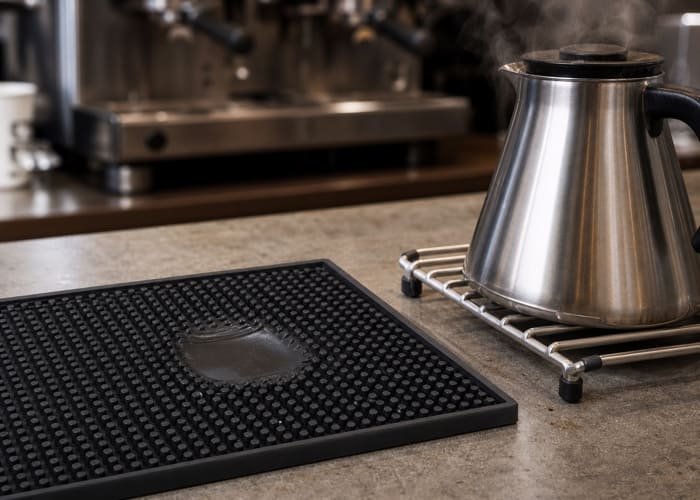
This is PVC's most significant weakness. Placing a hot coffee pot, a pan straight from the stove, or a steaming wand directly on a PVC mat will cause it to soften, warp, and potentially melt, leaving a permanent mark.
- Rule of Thumb: If the mat will be in constant contact with items hotter than 80°C (176°F), PVC is not the right choice.
- Alternative: For professional coffee bars or kitchen prep areas, a silicone mat is the superior option, as it can typically withstand temperatures up to 230°C (446°F).
2. Weaker Slip Resistance Than Rubber
While PVC provides adequate grip for most situations, pure rubber offers superior friction, especially on very smooth, wet surfaces like polished stainless steel or granite. A standard, smooth-backed PVC mat may slide slightly on such surfaces.
- Solution: When ordering PVC bar mats for slick counters, always specify a design with a textured or grid-like anti-slip pattern on the bottom. This dramatically improves its grip.
- Alternative: For high-movement areas where absolute stability is paramount, a heavy-duty rubber mat remains the king of non-slip performance.
3. Risk of Odor with Low-Quality Materials
The strong, chemical smell sometimes associated with PVC products comes from low-quality recycled materials or the use of cheap plasticizers like certain phthalates. These budget mats might be cheap, but the odor can be off-putting in a commercial environment.
- Solution: Always work with a reputable manufacturer who uses high-quality, virgin, or eco-friendly PVC. For projects targeting the EU or US markets, request materials that are compliant with standards like DOSEG, SVHC, or California Prop 65 to ensure safety and minimal odor. We facilitate this third-party testing for our clients regularly.
4. Not Suitable for Outdoor Use
- Rule of Thumb: If the bar mat is for an outdoor patio, rooftop bar, or poolside service area, do not use PVC.
- Alternative: Guma is far more resistant to UV radiation and temperature fluctuations, making it the correct choice for any outdoor application.
Pogosto zastavljena vprašanja
How long do PVC bar mats last?
With standard indoor use and regular cleaning, a high-quality PVC bar mat will typically last 2–3 years or more. Its lifespan depends on the intensity of use and exposure to harsh chemicals or heat. For promotional or light-use scenarios, it can last much longer.
Are PVC bar mats safe for bar and restaurant use?
ja, they are perfectly safe. Reputable manufacturers use non-toxic, food-safe grade PVC. For clients with strict compliance needs, such as those selling on Amazon or to major brands in the EU and USA, we can produce mats using materials that pass third-party tests like REACH, Prop 65, in LFGB.
What is the minimum order quantity for custom PVC bar mats?
The MOQ is one of PVC's biggest advantages. Pri SuperfectCraftu, our MOQ can be as low as 200 pieces per design, which is significantly lower than the 500-1000 piece minimums often required for rubber or silicone. This makes custom branding accessible to businesses of all sizes.
Can I get a PVC bar mat in a custom shape?
Vsekakor. The ability to be die-cut into intricate and unique shapes is a core strength of PVC. Whether you want a mat shaped like your logo, a bottle, or any other creative design, it can be done with clean, precise edges.
Zaključek
While rubber and silicone have their place as high-performance materials for specialized needs, PVC bar mats reign supreme as the undisputed king of value, versatility, in prilagajanje. Their unbeatable cost-effectiveness, friendly MOQs, and incredible design flexibility make them the default choice for the vast majority of applications. From massive promotional campaigns by global beverage brands to a small cafe's first branded counter mat, PVC delivers the most impact for the investment. It perfectly balances durability, aesthetics, and price, which is why it continues to dominate the market.
If you're looking for a cost-effective way to boost your brand presence with a durable, vibrant, and fully customized product, then PVC is your answer.
Ready to create your own custom PVC bar mats? Contact our team at SuperfectCraft today. We offer a free design sketch within 24 hours to help you visualize your project.
WhatsApp: +86 15816822766 E-pošta: sales01@superfectcraft.com
[^1]: "Polyvinyl chloride", https://en.wikipedia.org/wiki/Polyvinyl_chloride. An encyclopedia overview describes polyvinyl chloride (PVC) as one of the most widely produced synthetic plastics, valued for its low cost and ease of processing across many consumer applications, which provides general context for its popularity in products like bar mats; however, the source does not provide market-share data specific to bar mats. Dokazna vloga: splošna_podpora; vrsta vira: enciklopedija. podpira: PVC is widely produced and used due to low cost and versatile processing, which provides contextual support for its adoption in consumer products such as bar mats.. Opomba o obsegu: No bar-mat market data; support is contextual. [^2]: "Comparing PVC Colorant Formats: Pigments, Pastes ...", https://www.hollandcolours.com/markets/building-and-construction/comparing-pvc-colorant-formats-pigments-pastes-masterbatches-and-more. Materials guidance from a plastics industry association explains that PVC can be readily compounded with pigments and colorants to achieve specified colors, which supports the feasibility of close brand color matching; the source does not address Pantone‑specific tolerances or bar‑mat production variability. Dokazna vloga: splošna_podpora; vrsta vira: institution. podpira: PVC can be readily colored with pigments and colorants, enabling close matching to specified color standards.. Opomba o obsegu: No Pantone tolerance details; support is general to PVC coloring. [^3]: "Long-Term Effect of Ultraviolet Irradiation on Poly(vinyl ... - PMC", https://pmc.ncbi.nlm.nih.gov/articles/PMC6650850/. An encyclopedia discussion of PVC notes that the polymer is susceptible to photodegradation under ultraviolet light in the absence of stabilizers, providing mechanistic support for fading and embrittlement during outdoor exposure; the source does not quantify time‑to‑failure for specific products. Dokazna vloga: mehanizem; vrsta vira: enciklopedija. podpira: PVC undergoes photodegradation under UV radiation unless stabilized, which can lead to discoloration and embrittlement over time.. Opomba o obsegu: No exposure duration or product‑specific aging data.