
Finding a reliable bar mat supplier can feel like a complex task, especially when quality and brand reputation are on the line. You may encounter suppliers whose production samples look perfect, only to receive a bulk order that falls short. This disconnect wastes time, erodes your budget, and can damage your brand's image. The solution is a thorough vetting checklist to ensure your partner is qualified from the start.
To choose the right bar mat supplier, you must verify 20 key areas. These span five categories: factory qualifications and compliance, production and OEM capability, sample testing standards, design and tooling processes, and the commercial terms of your contract. A meticulous check ensures your supplier is a legitimate manufacturer with transparent processes and a commitment to quality.
Now that you have the high-level answer, let's dive into the specifics. This 20-point checklist is your roadmap to avoiding common pitfalls and building a successful partnership. It's the same framework we use to build trust with our clients every day.
What Factory Qualifications Should a Top Bar Mat Supplier Have?
Selecting a partner without verifying their legitimacy is a recipe for disaster. You might end up with a trading company posing as a factory, leading to poor communication and no control over quality. This puts your investment and production timeline at serious risk. A true manufacturer will have verifiable credentials that prove their expertise and operational stability.
The first step is to confirm the supplier's fundamental business qualifications and compliance records. A legitimate bar mat supplier will operate transparently, holding the necessary licenses, environmental permits, and a clean legal record. They should be willing to prove they are a manufacturer, not just a middleman.
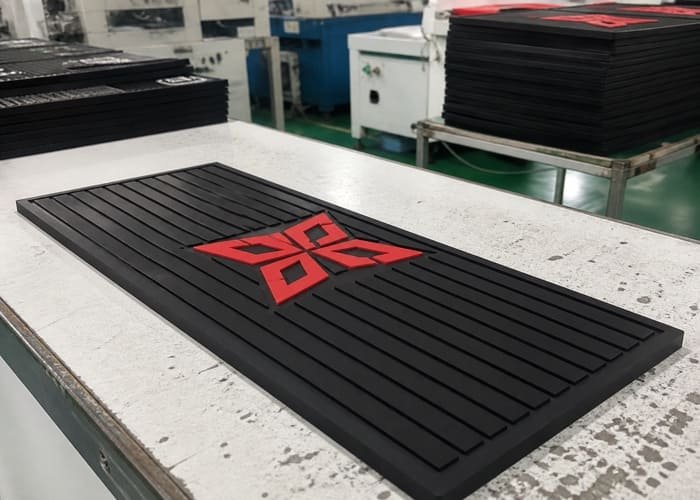
לצלול עמוק יותר: The 5-Point Compliance Check
A supplier’s paperwork tells a crucial story. It reveals whether they are a stable, compliant, and experienced manufacturer or a risky, fly-by-night operation. Here are the five non-negotiable items to verify.
- Business License Scope: The supplier's official business license must include "Plastic / PVC drip molding production and processing" (塑胶 / PVC 滴塑生产加工) or similar terms in its scope of business. If it only lists "sales" or "trading," they are not the manufacturer. This is the single most important check to ensure you are dealing directly with the factory.
- Environmental Compliance: Ask for their Environmental Impact Assessment (EIA) approval documents. Modern PVC production involves chemicals and generates emissions, so a responsible factory must have proper waste gas treatment facilities. A supplier without these permits faces the risk of being shut down by government inspections, which would halt your production indefinitely. Check for any record of environmental penalties.
- Material Safety Reports: A professional bar mat supplier should be able to provide batch-specific test reports from a CNAS-accredited lab. For standard commercial products, this includes tests for Phthalates (e.g., 6P-Free) and compliance with EU standards like REACH or RoHS. If the mat is for food-contact or bar-top use where it may touch glassware, insist on food-grade reports like FDA, LFGB, or EU10/2011.
- Factory Transparency: Never partner with a supplier who is vague about their location or unwilling to show you their facility. Ask for a live video tour of the entire factory, including the mold-making workshop, production lines, and warehouse. If they hesitate or only show you a polished showroom, it's a major red flag that they may be outsourcing production.
- Business History & Stability: Look for a supplier with at least 3 years of operational history. Use online business credit tools to check for a history of contract disputes or blacklisting. A stable operational history indicates experience and reliability. A brand-new company, while not automatically bad, carries a higher risk.
How Can You Verify a Supplier's OEM Production Capabilities?
Your custom design is unique, but it's worthless if the supplier can't actually make it. Many suppliers claim to have robust OEM capabilities but secretly outsource key processes like mold making or even the entire production. This leads to longer lead times, inconsistent quality, and a complete lack of control over your intellectual property.
To confirm true OEM capability, you must inspect their physical hardware and production processes. A vertically integrated bar mat supplier will have in-house control over the most critical steps, from creating the mold to final quality checks, ensuring your design is executed perfectly.
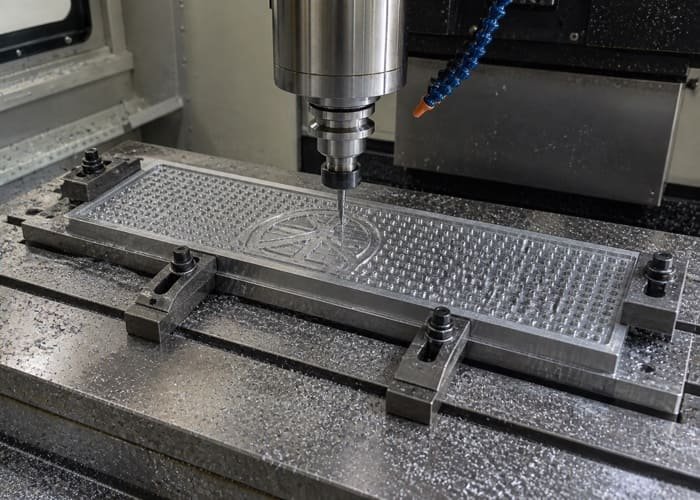
לצלול עמוק יותר: The 4-Point Hardware & Capability Check
True OEM/ODM partners invest in their own equipment. This investment gives them control over quality, speed, and cost. Here's how to tell the experts from the pretenders.
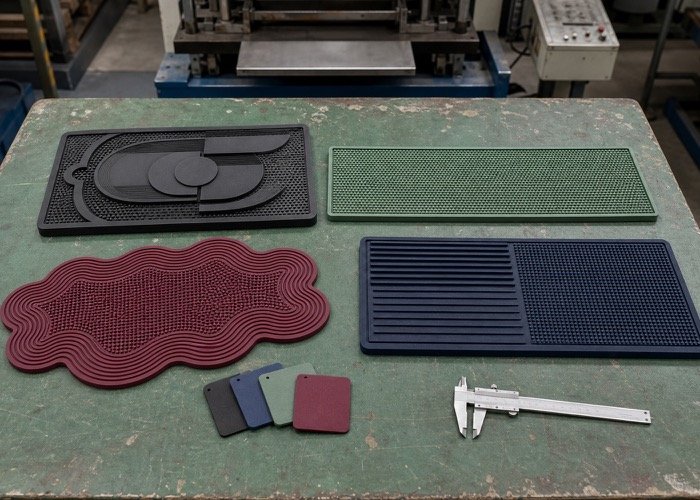
- In-House CNC Mold Workshop: Your mat's design, especially with 3D logos or complex textures, lives and dies with the mold. A top-tier supplier will have their own CNC carving workshop to create high-precision aluminum molds. They should be able to create multi-level embossed effects and custom shapes without outsourcing. Outsourcing molds adds weeks to your timeline and introduces communication errors. At SuperfectCraft, our in-house mold library and 24-hour design service are built on this capability.
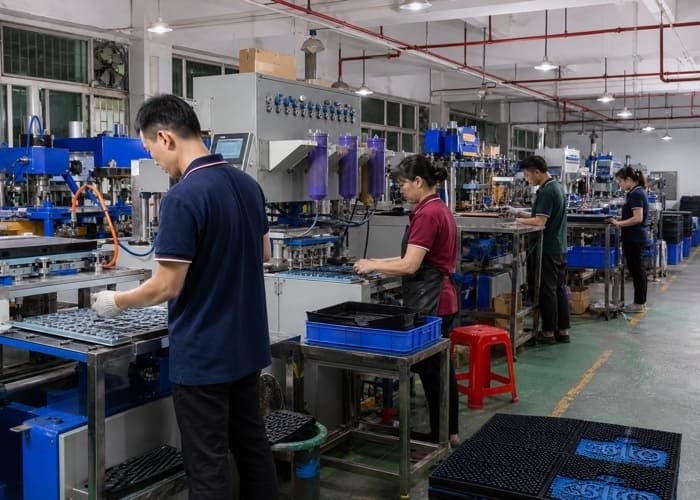
- Complete PVC Production Line: Ask for a tour of the full production line. A well-equipped factory should have automated or semi-automated processes for:
- Color Dispensing: Precisely mixing PVC colors.
- Logo Injection: Filling the mold with different colors.
- Vacuum Chamber: Removing air bubbles for a flawless finish.
- Sectional Ovens: Curing the PVC at controlled temperatures.
- Water-Cooling & Demolding: Safely removing the finished mat.
- Trimming & Finishing: Ensuring clean edges. If they can't show you this full process, they are likely just an assembly workshop or a trading company.
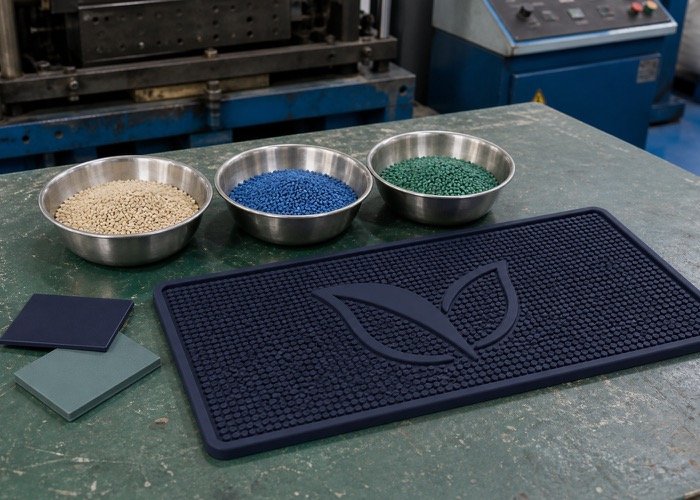
- Dedicated Raw Material Warehouse: A serious manufacturer will have a separate, clean warehouse for raw materials. They should commit in writing to using 100% new, eco-friendly PVC. Your contract should explicitly forbid the use of recycled or scrap materials, which can cause pungent odors, poor durability, and safety compliance failures.
- In-House Quality Lab: Quality control isn't just a final look-over. A professional bar mat supplier will have a dedicated lab space with tools for conducting routine tests. This includes calipers for dimensional accuracy, alcohol for wipe tests (logo durability), and containers for soak tests. They should maintain records for each batch.
What Are the Essential Standards for Testing Bar Mat Samples?
Receiving a sample is an exciting moment, but a visual check isn't enough. A low-quality mat might look good out of the box but will quickly fade, warp, or become sticky in a real-world environment. Approving a sample without rigorous testing can lead to a bulk order of unusable products and a significant financial loss.
The sample must be subjected to tests that simulate its actual use. This includes checking for odors, logo durability against common chemicals like alcohol, stability when wet, and precision in its physical form. These tests are the ultimate proof of a supplier's material and craftsmanship quality.
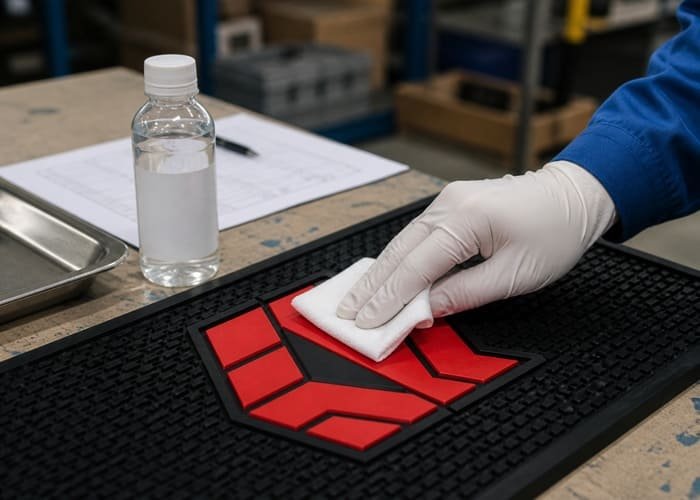
לצלול עמוק יותר: The 5-Point Sample Testing Checklist
Once the sample arrives, it's time to play the part of a skeptical customer. These five tests will reveal the true quality of the product.
- The Odor Test: After unboxing, let the sample air out for 24 שעות. A high-quality mat made from new, eco-friendly PVC will have a very faint, non-intrusive smell. If it emits a sharp, pungent, or "toxic" plastic odor, it’s a sign that the supplier used cheap, recycled materials. This odor will not go away and is unacceptable for any bar, salon, or restaurant.
- The Alcohol Wipe Test: This is non-negotiable for bar mats. Dampen a cloth with 75% isopropyl alcohol and rub the logo and colored sections firmly 20 times. A well-made mat will show no color transfer, fading, smudging, or blurring. If the color comes off, the logo will be destroyed within weeks of being used and cleaned in a real bar.
- The 24-Hour Soak Test: Submerge the mat in room-temperature water (or even better, a splash of beer or soda) for 24 שעות. After removing and drying it, inspect the surface. There should be no white film, stickiness, or oily residue. These are signs of plasticizer migration, a defect where chemicals leach out of the material, making it sticky and unsafe.
- The Physical Inspection: Lay the mat on a flat surface.
- Clarity: Embossed logos and patterns should have crisp, clean edges, not blurry or "melted" lines.
- Defects: Look for air bubbles, missing material (incomplete fill), color bleeding, and rough edges (burrs).
- Flatness: It should lay perfectly flat without any warping or curling at the edges.
- The Measurement & Finish Test: Use a caliper to check the dimensions and thickness against the specifications. A good supplier should achieve a tolerance of ±0.5mm. The surface should ideally have a matte or frosted texture. This not only looks more premium but also hides scratches and prevents glasses from sticking. A cheap, glossy finish reflects light poorly and shows every imperfection.
How Should a Professional Bar Mat Supplier Manage Design and Tooling?
The transition from a design file to a physical sample can be fraught with delays and misunderstandings. A supplier who isn't skilled in design interpretation may produce an inaccurate sample, forcing multiple expensive and time-consuming revisions. Furthermore, ambiguity around who owns the mold can create major problems for future orders.
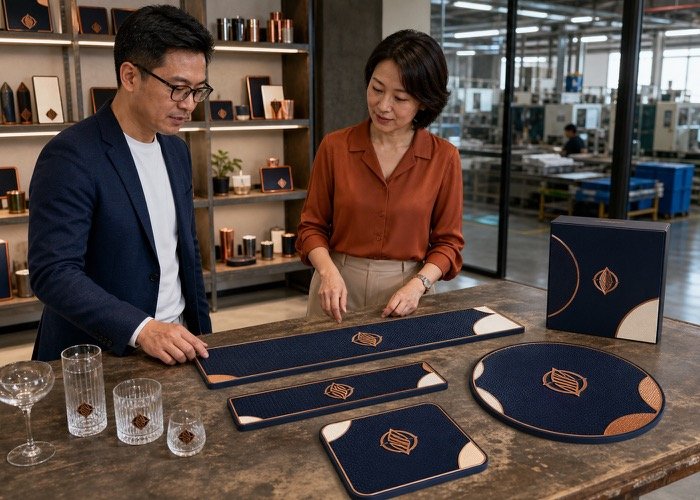
A customer-centric bar mat supplier streamlines this process. They should offer free design support, have a quick and clear sampling process, and establish transparent policies for mold ownership and confidentiality. This ensures your vision is translated accurately and your investment is protected.
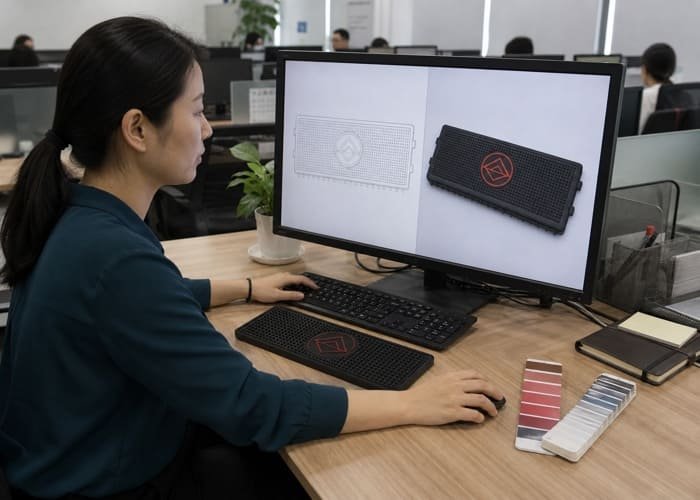
לצלול עמוק יותר: The 3-Point Design & Tooling Protocol
The pre-production phase sets the stage for the entire project. Clear communication and established procedures here are critical.
- Design Support & Sampling Speed: A great partner makes it easy for you. You should be able to provide your logo in a vector format (like an .AI file), and the supplier should create a professional production mockup for your approval, free of charge. For embossed designs, a typical sampling lead time should be 3–7 days. The supplier should also be accommodating to 2-3 minor revisions without complaint. At SuperfectCraft, our 24-hour sketch service is designed for exactly this.
- Mold Ownership & Confidentiality: This is a crucial point. The fee you pay is for creating a dedicated aluminum mold for your design. The supplier should store this mold for you free of charge for future re-orders, and re-orders should not incur another mold fee. Critically, they must agree not to use your custom mold for any other client, especially competitors. A formal non-disclosure agreement (NDA) can and should be signed to protect your design.
- The Pre-Production Sample (PPS): Before mass production begins, the supplier must produce a final "pre-production sample" from the approved mold. This single sample becomes the "golden standard." Both you and the supplier should sign off on it (or approve it via detailed photos/video). This PPS serves as the one and only benchmark for quality control when inspecting the final bulk order. Any deviation from this sample is grounds for rejection.
What Commercial and QC Terms Must Be in Your Contract?
A verbal agreement is not a plan. Without a detailed contract, you are exposed to hidden fees, sudden price hikes, missed deadlines, and poor quality with no recourse. An unprofessional supplier might demand 100% payment upfront, leaving you with no leverage if things go wrong.
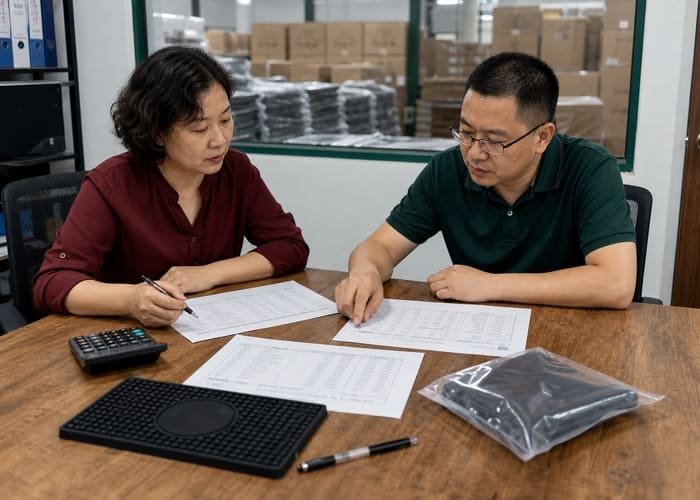
Your purchase order and contract must be detailed legal documents. They should transparently outline all costs, payment terms, quality standards, and penalties for failure. A trustworthy bar mat supplier will welcome this clarity, as it protects both parties and sets clear expectations for a successful partnership.
לצלול עמוק יותר: The 3-Point Contract Checklist
This is your final line of defense. Get these three areas specified in writing before you send a single dollar.
- Transparent Pricing & Fair Payment Terms:
- Itemized Quote: The quotation should break down all costs separately: mold fee, unit price, packaging costs, and any potential testing fees. There should be no hidden charges.
- Payment Structure: A standard and fair structure is a 30% deposit to start production and the remaining 70% balance paid after the goods have passed a final inspection but before they are shipped. Refuse any supplier that demands 100% prepayment.
- Written Quality & Delivery Guarantees:
- Defect Rate: The contract must specify a maximum acceptable defect rate (e.g., ≤2%).
- Supplier Responsibility: It should state that the factory is responsible for all costs of rework and two-way shipping if the products fail to meet the approved PPS standard (e.g., color mismatch, logo fading, wrong material).
- Late Delivery Penalty: The contract should include a clause that specifies a clear penalty for late delivery (e.g., a percentage of the order value per day/week of delay).
- Comprehensive Support Services: A good partner does more than just manufacture. Confirm they can provide:
- Custom Packaging: Options for custom-branded individual boxes, polybags, or master cartons.
- Export Documentation: All necessary paperwork for customs clearance in your country.
- Third-Party Inspection: The supplier must agree to accommodate a third-party inspector of your choosing to visit the factory for a final random inspection.
- After-Sales Support: A clear point of contact and response time for any issues discovered after you receive the goods.
שאלות נפוצות
What's the difference between a PVC, סיליקון, and rubber bar mat?
PVC is the most common material due to its excellent cost-performance ratio, ease of molding into complex logos, and good durability. Silicone is a more premium option, offering higher heat resistance and a softer feel, but at a higher cost. Rubber is extremely durable and heavy, making it great for high-traffic industrial areas but less common for detailed promotional mats.
Why is in-house mold making so important for a bar mat supplier?
In-house mold making gives the supplier direct control over the most critical part of creating a custom mat: translating your 2D design into a 3D physical tool. This results in faster sampling times, higher precision, easier revisions, and better protection of your intellectual property compared to suppliers who outsource this crucial step.
What is a reasonable Minimum Order Quantity (MOQ) עבור מחצלות בר מותאמות אישית?
For a custom design using a new mold, a typical MOQ ranges from 200 to 500 pieces per design. This is because the initial setup costs for mold creation and machine calibration are significant. At SuperfectCraft, we can often offer an MOQ of 200 pieces for designs based on our existing mold shapes, which helps new brands get started.
How long does it take to get custom bar mats produced?
The process generally involves a 3–7 day period for sample creation and approval. Once the sample is approved, mass production typically takes 20–30 days, depending on the order quantity and complexity. Always confirm this timeline with your supplier and get it in writing in your contract.
מַסְקָנָה
Choosing the right bar mat supplier is a strategic decision that directly impacts your brand quality, budget, and timeline. By moving beyond a simple price comparison and using this 20-point checklist, you can systematically evaluate a supplier's true capabilities. Focus on verifying their compliance, in-house production hardware, sample quality, design processes, and contractual terms. This diligence ensures you partner with a manufacturer who is technically proficient, transparent, and committed to your success.
If you are looking for a reliable OEM/ODM partner who meets these high standards, we are here to help. Contact SuperfectCraft today to discuss your project, and let us show you how our in-house capabilities and transparent process can bring your custom bar mat vision to life.