
Težko najti dobavitelja za barske preproge vaše blagovne znamke po meri? You know that finding the right bar mat factory is critical, but the sheer number of options can feel overwhelming, and making the wrong choice can lead to costly delays and poor-quality products that damage your brand's reputation. This guide provides a clear roadmap to help you confidently select the perfect manufacturing partner for your business.
To find the right bar mat factory, first identify the main manufacturing hubs in China, such as Dongguan, Wenzhou, and Yiwu. Naprej, decide whether you need an OEM factory for a fully custom design or an ODM factory to leverage existing molds. Finally, vet potential partners on their material expertise (PVC, guma, silikon), sample production process, quality control, and ability to meet compliance standards for your target market.
Now that you have the quick answer, the details are what truly separate a successful sourcing project from a failed one. Let's break down the specific materials, factory types, and critical capabilities you need to evaluate to ensure you make the best possible choice.
What Are the Main Types of Bar Mats and Where Are They Made?
Feeling lost in a sea of materials like PVC, guma, and silicone? Wondering where in the world these products actually come from? Understanding the material options and the geography of production is the first step in narrowing your search.
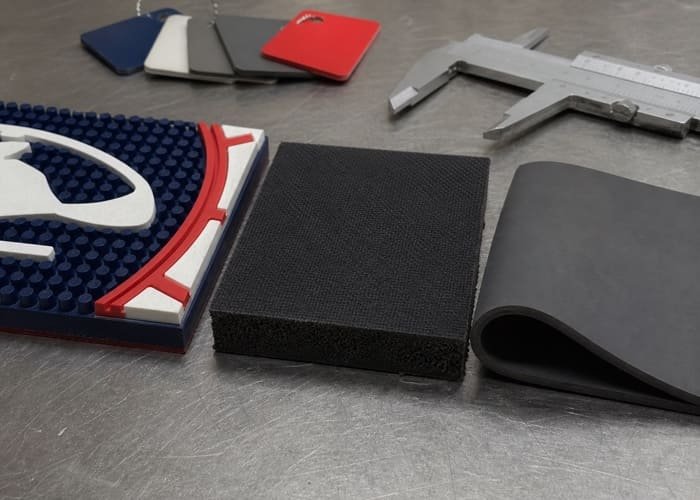
The vast majority of custom bar mats are made from PVC, guma, or silicone, with some featuring a non-woven fabric top for printed graphics. Production is highly concentrated in a few key industrial cities in China, each with its own unique strengths.
Potopite se globlje: Materials and Manufacturing Hubs
Choosing the right material is a balance of aesthetics, funkcijo, and budget. Each option has distinct advantages that make it suitable for different applications.
Material Breakdown: PVC vs. Rubber vs. Silikon
-
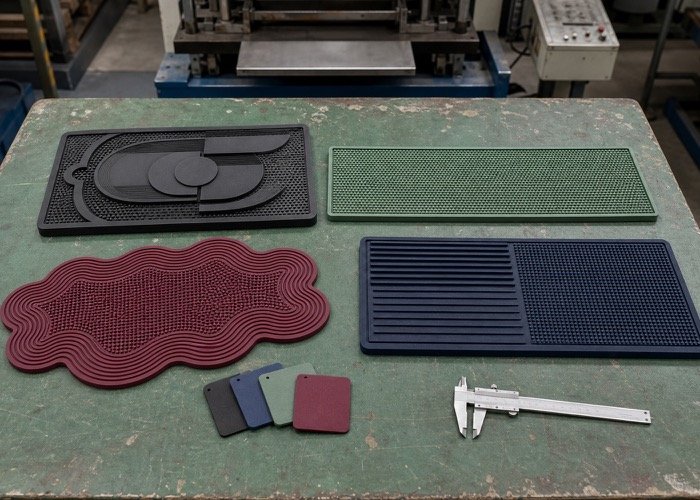
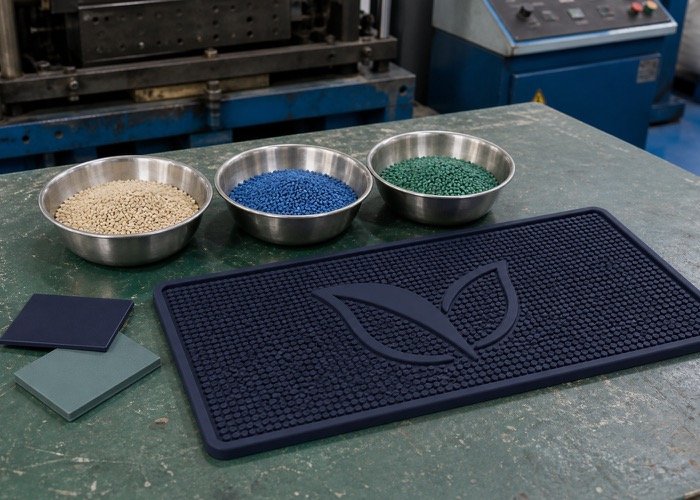
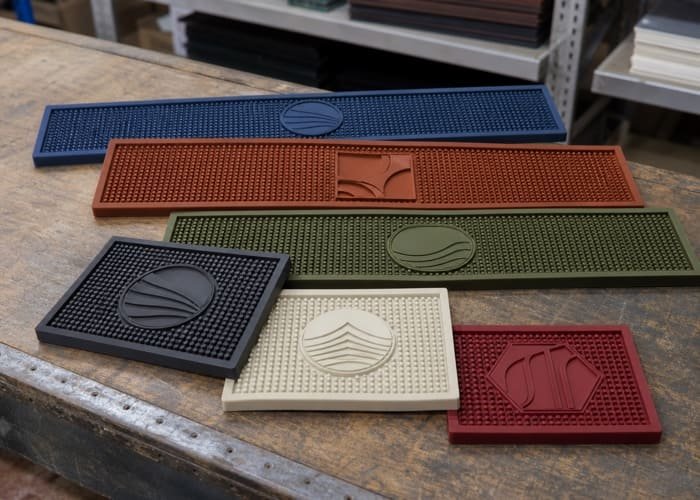
PVC (Soft PVC Drip Glue): This is the most popular choice for promotional bar mats, and for good reason. The PVC dispensing process allows for incredibly detailed, multi-level, and vibrant logos with sharp, clean lines. It's cost-effective and durable enough for most bar and restaurant environments. Pri SuperfectCraftu, this is one of our core specialties, as it offers amazing design flexibility for brands.
-
Guma (Nitrile Rubber Base): Often paired with a non-woven fabric top, rubber-based mats are prized for their durability and heavy-duty feel. The design is typically printed onto the fabric surface using dye-sublimation, which allows for full-color, photorealistic images.[^1] These mats are heavier, lie perfectly flat, and offer excellent grip, making them ideal for high-traffic commercial bars or industrial workstations.
-
Silikon: This is the premium option. Silicone is extremely durable, prilagodljiva, odorless, and has very high heat resistance.[^2] It's often chosen for barber mats or tool mats where hot clippers or tools might be placed. Nadalje, silicone can be made to meet food-grade standards like FDA and LFGB[^3], making it suitable for applications where it might come into contact with glassware for consumption.
To make it easier, here is a quick comparison table:
| Funkcija | PVC palica Mat | Gumijasta palica | Silikonska palična podloga |
|---|---|---|---|
| Podrobnosti logotipa | Odlično (3D Molded) | Dobro (Printed) | Zelo dobro (Molded) |
| Vzdržljivost | Dobro | Odlično | Odlično |
| Odpornost na vročino | Zmerno | visoko | Zelo visoko |
| Stroški | Nizka | Medium | visoko |
| Flexibility | Dobro | Zmerno | Odlično |
| Best For | Promotions, Brands | High-Traffic Bars, Photos | Postrežba hrane, Sejmi, Tools |
Geographic Manufacturing Hubs in China
While you can find suppliers everywhere, production is concentrated in a few key areas:
- Dongguan: Located in the Pearl River Delta, Dongguan is a global hub for high-quality plastic, silikon, and rubber manufacturing.[^4] Factories here, including our own, are known for their technical expertise, handling of complex designs, and strong export focus. If you need a reliable partner for a major brand project, Dongguan is the first place to look.
- Wenzhou (Cangnan): This city is another major center for printing and plastics, including bar mats. It's known for being highly competitive on price and is a strong player in the market.
- Yiwu: Famous for its massive international wholesale market[^5], Yiwu is a great source for smaller quantity orders and ready-made "stock" products. Many trading companies are based here, sourcing from factories across China.
Should You Choose an OEM or ODM Bar Mat Factory?
Do you have a completely unique design that needs to be brought to life, or are you looking for a faster, more cost-effective way to get a branded mat to market? This question is at the heart of choosing between an OEM and an ODM factory.
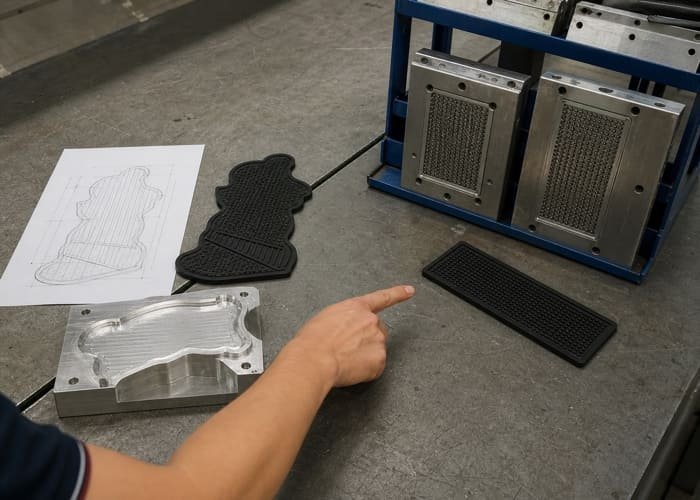
Simply put, choose an OEM (Original Equipment Manufacturer) bar mat factory if you have a custom design that requires creating a new, private mold. Opt for an ODM (Original Design Manufacturer) factory if you prefer to use their existing product designs and simply add your logo and colors.
Potopite se globlje: OEM vs. ODM Production Models
Your choice here will fundamentally shape your product development timeline, budget, and the uniqueness of your final product. I've worked with hundreds of clients, and guiding them through this decision is one of the most important first steps.
The OEM (Original Equipment Manufacturer) Path
An OEM partnership is a true collaboration to create something new.
- The Process: You provide the factory with your detailed artwork, dimenzije, and technical specifications. The factory then engineers a solution, creates a brand-new production mold based on your design, and manufactures the product exclusively for you.
- Pros:
- Total Creative Control: The final product is 100% your vision.
- Brand Exclusivity: No other company can sell a product with the same shape and features.
- Competitive Advantage: A unique product helps you stand out in the market.
- Cons:
- Higher Upfront Cost: You must pay a one-time fee for the new mold, which can range from several hundred to a few thousand dollars.
- Longer Lead Time: Mold creation and testing add several weeks to the project timeline.
- Best For: Established brands, companies launching a signature product line, or anyone with a specific functional or aesthetic requirement that doesn't exist on the market. Our 24-hour design sketch service is specifically designed to help OEM clients visualize their idea before committing to a mold.
The ODM (Original Design Manufacturer) Path
An ODM approach is about speed, učinkovitost, and lower risk.
- The Process: The factory offers a catalog or library of existing product molds. You select a shape and size you like, and the factory customizes it with your logo, brand colors, and packaging.
- Pros:
- No Mold Fee: This dramatically reduces the initial investment.
- Faster Production: Since the mold already exists, you can move directly to sample production, cutting weeks off the timeline.
- Lower MOQ: Factories are often willing to accept smaller order quantities for their existing designs.
- Cons:
- Limited Uniqueness: The base shape of your product is not exclusive, and your competitors could potentially use the same mold from the same factory.
- Best For: Startups, promotional product distributors, businesses running a specific campaign with a tight deadline, or companies looking to test the market with a smaller investment. Our large library of existing molds gives clients a huge head start.
What Key Capabilities Should You Look for in a Bar Mat Factory?
You've identified the right material and production model. Now, how do you separate an excellent bar mat factory from a merely average one? It comes down to verifying their capabilities and processes.
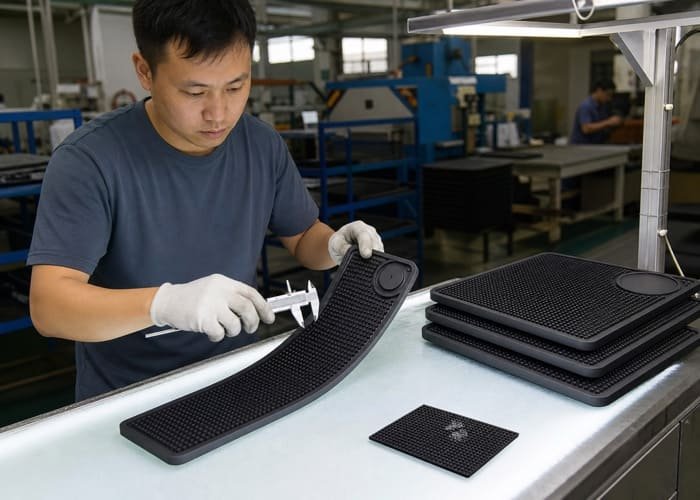
A top-tier bar mat factory must demonstrate strong design support, a transparent sample approval process, robust quality control systems, proven experience with material compliance for your target market, and broad customization options that go beyond just a logo.
Potopite se globlje: Vetting Your Potential Partner
During my years in this industry, I've seen that a factory's internal processes are the best predictor of a successful outcome. Don't be afraid to ask detailed questions about the following areas.
-
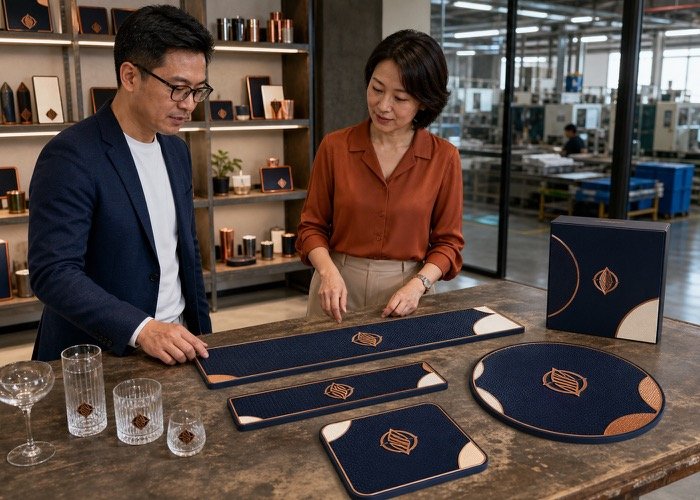
Design and Prototyping Support A great partner acts as a consultant. Ask them: Can you create a design sketch based on just my logo and dimensions? How quickly can you provide it? A factory that offers free, fast design support (like our 24-hour sketch service) shows they are invested in helping you succeed, even if you don't have in-house designers.
-
The Sample Confirmation Process This is non-negotiable. Never place a bulk order without approving a physical pre-production sample. A professional factory will have a clear, multi-step process for creating this sample, which should look something like this:
- Barvno ujemanje: Precisely matching your Pantone color codes.
- Dispensing: Programming the machines to inject the liquid PVC or silicone for your logo.
- Molding: Curing the material in the oven to create the final solid mat.
- Inspection & Packing: Trimming excess material and checking for defects before shipping the sample to you. A typical sample lead time is around 7 dni. This step prevents costly errors in mass production.
-
Material and Compliance Expertise Selling in the EU, California, or on Amazon? Your product may need to meet specific chemical safety standards. A factory that asks about your target market is a good sign. They should be knowledgeable about tests like:
- DOSEG / SVHC (for the EU market)
- California Proposition 65
- FDA / LFGB (for food-grade silicone)
- Phthalate and Heavy Metal content While you, the importer, are ultimately responsible for compliance, a good factory can arrange for third-party testing and manufacture using materials that will pass.
-
Production Capacity and Quality Control Be clear on the numbers. Ask about their Najmanjša količina naročila (MOQ); for ODM projects using existing molds, an MOQ of 200 pieces is a reasonable starting point. Also, confirm their mass production lead time, which is typically 20–30 days after sample approval. Most importantly, ask about their final inspection process. Do they check every unit before it's packed and shipped? This final QC step is your last line of defense against defects.
Pogosto zastavljena vprašanja
Kolikšna je najmanjša količina naročila (MOQ) za barske podloge po meri?
The MOQ varies by factory and project type. For ODM projects using a factory's existing mold, the MOQ can be as low as 200 pieces per design. For fully custom OEM projects that require a new mold, the MOQ may be higher, often starting around 500 pieces to justify the setup costs.
How much does a custom mold for a bar mat cost?
A custom mold is a one-time investment for an OEM project. The cost typically ranges from $300 to $3,000 USD. The price depends heavily on the size of the mat, the complexity of the 3D logo details, and the material of the mold itself (npr., aluminum vs. steel).
Do I need safety certifications for my bar mats?
It depends entirely on your product's material and your target market. For standard promotional use, specific certifications are often not mandatory. Vendar, if you are selling in the European Union (DOSEG), California (Prop 65), or for applications involving food contact (FDA), testing is essential. Your factory should be able to advise you and arrange for third-party testing.
How long does it take to get a sample?
After you approve the final design sketch, a professional bar mat factory can typically produce and ship a physical sample within 7 to 10 dni. This timeline includes processes like color matching, mold setup, material injection, and curing.
Zaključek
Finding the right bar mat factory is a strategic decision that directly impacts your product quality, budget, in podobo blagovne znamke. By understanding the core material types, knowing the difference between OEM and ODM production, and thoroughly vetting a factory's capabilities—from design support and sampling to quality control and compliance—you can forge a strong, reliable partnership. This methodical approach transforms a daunting task into a manageable process, ensuring your vision is executed flawlessly and your product stands out for all the right reasons.
If you're looking for an experienced and reliable bar mat factory with deep expertise in both custom OEM and fast-turnaround ODM production, our team is ready to help. We have the technology, the experience, and a commitment to quality that global brands trust.
Contact us at SuperfectCraft today for a free design sketch and a no-obligation quote to bring your project to life.
- WhatsApp: +86 15816822766
- E-pošta: sales01@superfectcraft.com
- Website: www.superfectcraft.com
[^1]: "Dye-sublimation printing", https://en.wikipedia.org/wiki/Dye-sublimation_printing. Technical overviews explain that dye‑sublimation printing produces continuous‑tone, photo‑quality images on polyester or polymer‑coated substrates, which supports the claim of full‑color, photorealistic results on fabric tops. Dokazna vloga: mehanizem; vrsta vira: enciklopedija. podpira: Dye-sublimation’s ability to produce continuous-tone, full-color prints on polyester or polymer-coated substrates. Opomba o obsegu: Optimal results require polyester or a polymer-coated fabric; performance on other substrates may vary. [^2]: "Silicone rubber", https://en.wikipedia.org/wiki/Silicone_rubber. Reference works describe silicone rubber as flexible, chemically inert, and thermally stable typically up to about 200–250°C, consistent with its characterization as durable, low-odor, and highly heat resistant. Dokazna vloga: splošna_podpora; vrsta vira: enciklopedija. podpira: Typical physical and thermal properties of silicone rubber. Opomba o obsegu: Exact performance depends on the specific silicone formulation and additives. [^3]: "What is FDA Food Grade Silicone made up of?", https://silicone.co.uk/news/what-is-fda-food-grade-silicone-made-up-of/. Encyclopedic summaries note that silicone rubber is widely used in food-contact applications such as bakeware and kitchenware, reflecting its suitability for meeting regulatory food-contact requirements when formulated appropriately. Dokazna vloga: splošna_podpora; vrsta vira: enciklopedija. podpira: Silicone rubber’s common use in food-contact applications due to inertness and heat resistance. Opomba o obsegu: This does not confirm FDA or LFGB compliance for any specific product; compliance depends on exact formulation and testing. [^4]: "The Transformation of Dongguan's Manufacturing Industry", https://ongloballeadership.com/f/the-transformation-of-dongguan%E2%80%99s-manufacturing-industry. Encyclopedic overviews note Dongguan as a major manufacturing center in China’s Pearl River Delta with extensive export-oriented industry, which supports the description of its role in plastics and rubber manufacturing. Dokazna vloga: splošna_podpora; vrsta vira: enciklopedija. podpira: Dongguan’s status as a major manufacturing center in the Pearl River Delta with extensive industrial capacity. Opomba o obsegu: The source does not itemize bar mat factories; it substantiates the city’s manufacturing prominence generally. [^5]: "Yiwu Small Commodity Market - All You SHOULD Know ...", https://www.tripadvisor.com/Attraction_Review-g608468-d3362468-Reviews-Yiwu_Small_Commodity_Market-Jinhua_Zhejiang.html. Encyclopedic sources describe Yiwu International Trade City as one of the world’s largest wholesale markets for small commodities, aligning with its role as a hub for ready-made stock products and small-quantity purchasing. Dokazna vloga: splošna_podpora; vrsta vira: enciklopedija. podpira: Yiwu’s status as a major international wholesale market for small commodities and stock goods. Opomba o obsegu: The source does not address bar mats specifically; it supports Yiwu’s general wholesale profile.