
Are you considering promotional items but feel overwhelmed by the seemingly complex production process? This lack of clarity can make you worry about quality, fearing that your brand's logo might end up looking cheap or distorted. Understanding exactly how a custom bar mat is manufactured demystifies the entire journey, giving you the confidence to invest in a product that truly represents your brand's standards.
A custom bar mat is manufactured through a multi-stage process starting with material preparation, where colored PVC liquid is mixed. An aluminum mold is engraved with the design. The core step is automated dispensing, where machines inject colors for the logo and base. The mat is then vacuum-sealed to remove bubbles, baked to solidify, cooled, and trimmed. Endlich, it undergoes strict quality control before packaging.

Now that you have a high-level overview of the production, let's break down each step. Seeing the precision and care involved will give you complete confidence in the quality of the final product you'll receive for your business.
What Happens Before a Custom Bar Mat Hits the Production Line?
Ever wonder what goes into the vibrant colors and durable feel of a high-quality bar mat? It’s not just random plastic. Using the wrong material mix can lead to fading colors, a sticky surface, or a strong chemical smell. We prevent this by starting with a precise, high-quality formula to guarantee excellence from the very first step.
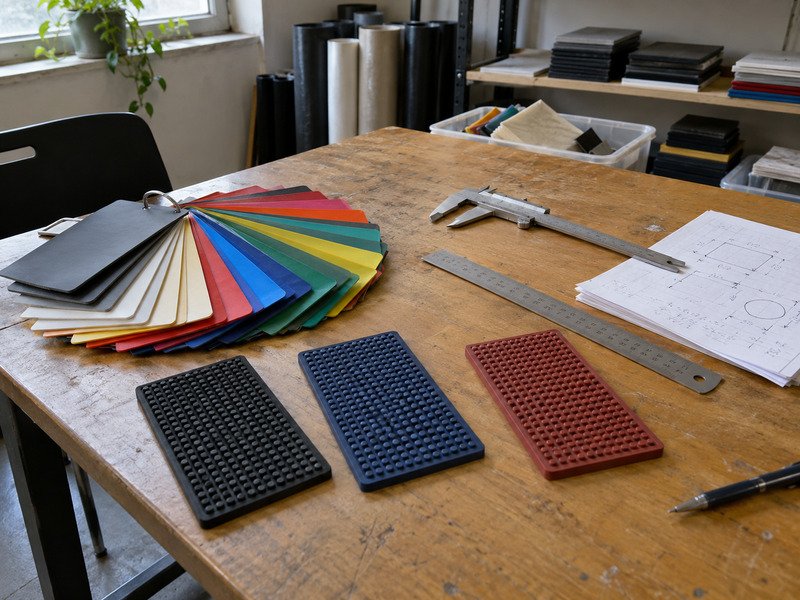
The pre-production stage involves two parallel paths: preparing the raw materials and creating the mold. We formulate the liquid PVC by mixing eco-friendly PVC powder with plasticizers, stabilizers, and Pantone-matched color pastes. Simultaneously, a custom aluminum mold is CNC-engraved based on your design, creating the 3D logo and drainage channels.
The Perfect PVC Recipe
The foundation of a superior custom bar mat is its material composition. We don't leave this to chance. The process begins by creating a liquid PVC, often called plastisol, with a specific recipe designed for durability, safety, and visual appeal.
Here are the core components:
- Eco-Friendly PVC Powder: We start with brand new, environmentally friendly PVC resin, not recycled materials. This ensures consistency and compliance with safety standards.
- Phthalate-Free Plasticizer: This agent gives the mat its flexibility. We use non-phthalate plasticizers to meet stringent international regulations like REACH and California Proposition 65.
- Calcium-Zinc Stabilizer: This compound prevents the PVC from degrading during the high-temperature baking process, ensuring a long-lasting and stable product.
- Pantone-Matched Color Paste: To achieve your exact brand colors, we mix in concentrated color pastes. We can match any color from the Pantone Matching System (PMS) to ensure perfect brand consistency.
These ingredients are poured into a large industrial agitator and mixed thoroughly until they form a smooth, homogenous, colored liquid ready for the dispensing machines.
Crafting the Precision Aluminum Mold
While the PVC is being mixed, your design is being brought to life in metal. We take your digital artwork (usually an Adobe Illustrator or PDF file) and use it to program a CNC (Computer-Numerische Steuerung) Maschine. This machine meticulously engraves a block of aluminum to create the production mold.
The mold includes several critical features:
- Embossed Logo & Patterns: The CNC machine carves out the negative space for your logo and any surface textures, creating the raised, 3D effect on the final product.
- Drainage Nibs & Channels: The small posts and channels that hold liquid are precisely engraved into the mold surface.
- Color-Separation Grooves: For multi-color designs, this is a crucial detail. We engrave very fine, thin walls into the mold that act as barriers. These grooves keep the different liquid PVC colors from bleeding into one another, ensuring crisp, klare Linien.
If you only have a logo and an idea, that’s no problem. Our 24-hour design sketch service can turn your concept into a production-ready file for free.
How is the Logo and Base of a Custom Bar Mat Formed?
A blurry logo or muddled colors can instantly devalue a promotional product. So, how do we ensure every custom bar mat has a crisp, lebendig, multi-colored design? The secret lies in a precise, automated process that builds the mat layer by layer with robotic accuracy.
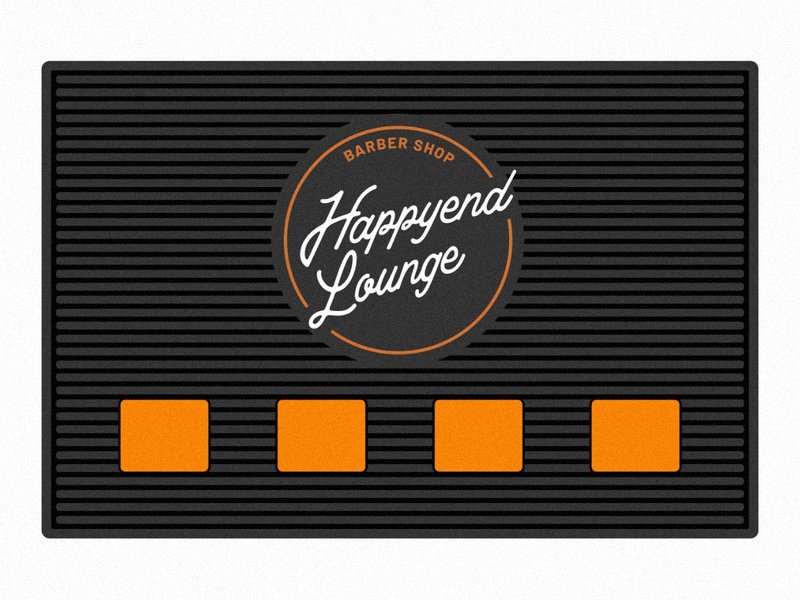
The core manufacturing stage is automated liquid dispensing. Erste, the aluminum mold is pre-heated and placed on a production line conveyor. A computer-controlled machine injects the specific colors for the logo and detailed patterns. This layer is briefly dried, and then the primary background color is poured to fill the rest of the mold, forming the mat's main body.
The Step-by-Step Dispensing Process
This automated process is the heart of PVC bar mat manufacturing, where your design truly takes shape. I remember being fascinated the first time I saw it in action; it's like a 3D printer for flexible PVC.
- Mold Pre-heating: The empty aluminum mold is heated to a specific temperature. This initial heat helps the liquid PVC flow smoothly into all the tiny crevices of the engraved design, ensuring every detail is captured.
- Layered Color Injection (Logo First): The heated mold moves under the dispensing machine. Guided by the design file, robotic arms with fine needles inject the colored PVC for the logo and other graphic elements first. If your design has five colors, the machine will apply all five in their designated spots before moving on.
- Low-Temperature Setting: After the logo colors are applied, the mold passes through a short, low-temperature oven. This doesn't fully cure the PVC but solidifies it just enough to "set" the logo. This step is critical for preventing the logo colors from mixing with the base color in the next stage.
- Base Color Filling: Endlich, the main background color is dispensed, filling the rest of the mold's area and depth. This liquid flows around the set logo, forming the solid body of the custom bar mat.
The Critical Vacuum and Baking Stages
With the mold full of liquid PVC, two final steps are needed to transform it into a solid, durable product.
Vacuum Degassing: The filled mold is immediately placed inside a vacuum chamber. The machine sucks all the air out of the chamber, which also pulls any trapped air bubbles out of the liquid PVC. Skipping this step would result in tiny pinholes or blemishes on the surface of the finished mat—a clear sign of low-quality manufacturing.
High-Temperature Curing: The bubble-free mold then travels through a long, multi-zone oven heated to between 180°C and 200°C (356°F to 392°F). This sustained high heat triggers a chemical reaction that permanently solidifies, or "cures," the liquid PVC into the flexible, solid rubbery material you know. This ensures the final product is not sticky or soft and will withstand years of use.
What Final Touches Ensure a Perfect Custom Bar Mat?
A great design can be completely undermined by rough edges, hidden defects, or inconsistent dimensions. How do you guarantee that every single mat in an order of 200 oder 2,000 is flawless? It all comes down to the meticulous finishing and quality control steps that separate premium products from cheap alternatives.
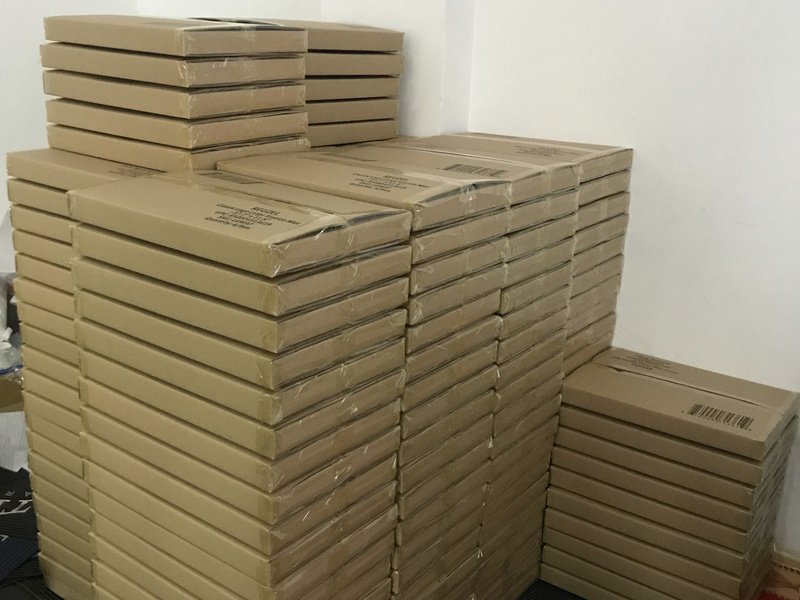
After baking, the hot mold is cooled with water, and the solidified custom bar mat is carefully peeled out. Any excess material (known as "flash") around the edges is trimmed by hand or machine for a perfectly smooth finish. Each mat then undergoes a strict visual inspection for defects before select samples are pulled for rigorous performance testing.
Demolding and Trimming
Once the mat is fully cured in the oven, the mold is still extremely hot. It's moved to a cooling station, where water is run over it. This rapid cooling causes the aluminum mold and the PVC mat to contract at different rates, making it much easier to separate them.
An operator then carefully peels the finished mat out of the mold. At this stage, there is often a thin, wispy bit of extra material around the outer perimeter—this is called "flash" or "burrs." A skilled worker then uses a sharp cutting tool to meticulously trim this flash away, ensuring the edges are smooth, clean, and perfectly match the intended shape, whether it's a simple rectangle or a custom die-cut contour.
The Two-Tier Quality Check
This is where our commitment to quality really shines. Every single custom bar mat that comes off our line goes through a two-stage quality assurance process.
1. Piece-by-Piece Visual Inspection: Every mat is placed on an inspection table under bright lights and is checked by a trained inspector. They are looking for any of the following issues:
- Bubbles or Pinholes: Evidence that the vacuum degassing step failed.
- Missing Material: Incomplete filling of the mold.
- Color Discrepancies: Colors that don't match the approved sample or have bled into each other.
- Incomplete Logos: Any part of the embossed logo that isn't crisp and fully formed.
- Warping or Curling: The mat must lie perfectly flat.
- Uneven Thickness: The mat's thickness must be consistent across its entire surface.
Any mat with even a minor defect is immediately rejected and scrapped. It never makes it to packaging.
2. Batch Performance Testing: For every production run, we randomly select a few finished mats for a series of simple but effective performance tests:
- Color Fastness Test: We vigorously wipe the logo with a cloth soaked in 75% alcohol. The color must not fade or transfer to the cloth.
- Chemical Resistance Test: A sample is submerged in strong liquor for 24 Std.. Afterward, it should show no signs of whitening, stickiness, or degradation.
- Geruchstest: We check for any pungent, unpleasant plastic odors. A properly cured mat should have a neutral smell.
- Dimensional Accuracy Test: Using digital calipers, we measure the length, Breite, and thickness to ensure they are within the precise tolerances specified in the order.
Only after passing these rigorous checks is the batch approved for final packaging and shipment.
Is the Process Different for Rubber Bar Mats?
While PVC is the most popular choice for its vibrant, 3D logo capabilities, some brands prefer the classic weight and feel of a rubber bar mat. But is the manufacturing process the same? Not at all. Understanding the key differences helps you choose the perfect material and process for your specific project.
Ja, the manufacturing process for rubber bar mats is fundamentally different. It begins with mixing solid raw rubber, which is then pressed into sheets. These sheets are placed in a mold and subjected to immense heat and pressure in a process called vulcanization[^1]. The logo is typically silk-screen printed onto the flat surface nach the mat has been formed.
The Vulcanization Process
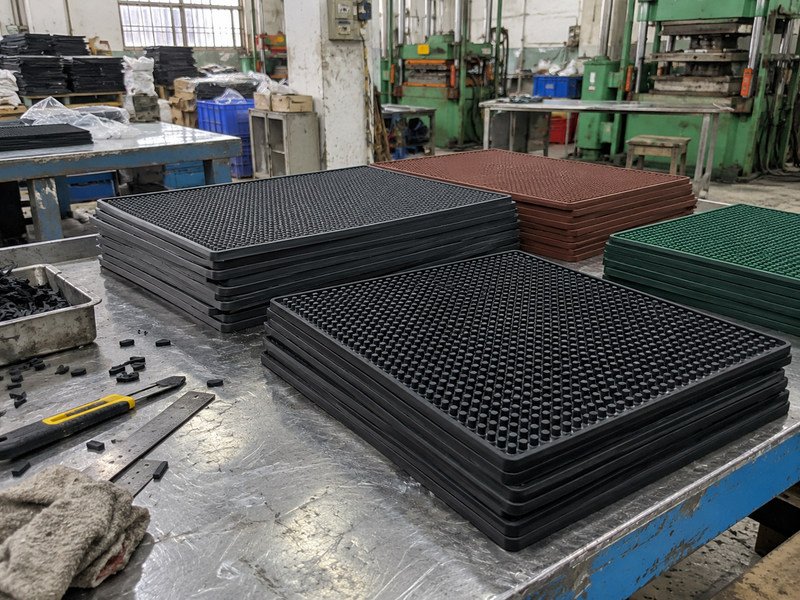
The primary difference is that PVC mats are made from a liquid that is poured, while rubber mats are made from a solid that is compressed.
The process for a rubber mat looks like this:
- Material Compounding: Raw rubber (like Nitrile or NBR) is mixed with curing agents, color pigments, and other additives in a large mill.
- Sheeting: The compounded rubber is then fed through rollers (a process called calendering) to create large sheets of a consistent, specified thickness.
- Compression Molding: A piece of the rubber sheet, cut to size, is placed into a heated steel mold. The mold is closed in a massive hydraulic press, which applies immense pressure and heat. This forces the rubber to flow into the mold's shape and triggers vulcanization—the chemical process that cross-links the rubber molecules, giving it strength, elasticity, and durability.
Logo Application and Finishing
Another major distinction is how the logo is applied.
- Surface Printing: Unlike PVC's integrally molded 3D logo, the branding on a rubber mat is almost always applied to the surface after molding. The most common and durable method is silk-screen printing[^2]. A screen (or stencil) of the logo is created, and specialized ink is pushed through the screen onto the mat's surface, one color at a time.
- Post-Baking: After printing, the mats are often baked again at a lower temperature. This step serves to fully cure the screen-printing ink and also helps dissipate some of the natural rubber odor.
- Finishing: Endlich, just like with PVC mats, the rubber mats are inspected, trimmed of any flash, and checked for quality before being packaged.
PVC vs. Rubber Manufacturing at a Glance
| Besonderheit | PVC Drip-Molded Bar Mat | Rubber Compression-Molded Bar Mat |
|---|---|---|
| Material State | Liquid (Plastisol) | Solid (Rubber Sheets) |
| Molding Process | Liquid injection & dispensing | High-pressure compression & vulcanization |
| Logo Integration | Integrally molded (3D, geprägt) | Surface-printed (z.B., silk-screen) |
| Color Complexity | Excellent for multi-color, intricate designs | Best for 1-2 color logos; complex colors are harder |
| Key Advantage | High-detail 3D logos and vibrant color | Extreme durability and classic, weighty feel |
Häufig gestellte Fragen
Was ist die Mindestbestellmenge? (Mindestbestellmenge) for a custom bar mat?
Our typical MOQ is 200 Stück pro Design und Farbe. This is especially efficient if you use one of our hundreds of existing molds, as it allows for cost-effective production runs while still providing a high degree of logo and color customization for your brand.
Wie lange dauert es, eine Probe zu erhalten??
Once you approve the digital design sketch, we can produce and ship a physical sample within 7 Tage. This is a vital step in our process. It allows you to see and feel the quality, confirm the colors are perfect, and approve all details before we commit to mass production.
Can you help me create a design if I only have a logo?
Absolut. We specialize in supporting clients who may not have in-house design resources. Wir bieten einen kostenlosen 24-Stunden-Service für Designskizzen an. Simply provide us with your logo file, gewünschte Abmessungen, and any creative ideas, and our team will prepare a professional mockup for your review and approval.
What materials are used, and are they safe?
We primarily manufacture mats from eco-friendly PVC, nitrile rubber, and silicone. Our standard materials are perfectly safe for all commercial applications. For projects targeting specific markets like the EU, USA, or for sale on Amazon, we can arrange third-party compliance testing for REACH/SVHC, Kalifornien Prop 65, FDA/LFGB, und mehr.
Abschluss
From a precise recipe of raw materials to a finished product that protects your bar and promotes your brand, the journey of a custom bar mat is a testament to modern manufacturing precision. The process combines material science, CNC technology, and meticulous human oversight. By understanding the key stages—material formulation, mold creation, automated dispensing, and uncompromising quality control—you can be assured that you are investing in a premium promotional tool. This attention to detail is how we guarantee a product that proudly represents your brand.
Ready to bring your own custom bar mat design to life? Kontaktieren Sie uns noch heute to get a free design sketch and a no-obligation quote.
[^1]: "Vulcanization", https://en.wikipedia.org/wiki/Vulcanization. Vulcanization is a chemical process that cross-links rubber molecules, enhancing its strength, elasticity, and durability. Beweisrolle: Mechanismus; Quelltyp: Forschung. Unterstützt: Vulcanization strengthens rubber by cross-linking its molecules.. Hinweis zum Umfang: Specific results depend on the type of rubber and curing agents used. [^2]: "Screen printing", https://en.wikipedia.org/wiki/Screen_printing. Silk-screen printing is widely used for logo application on rubber mats due to its durability and ability to produce sharp, high-quality designs. Beweisrolle: general_support; Quelltyp: Ausbildung. Unterstützt: Silk-screen printing is a durable method for applying logos to rubber mats.. Hinweis zum Umfang: Durability may depend on ink quality and curing processes.