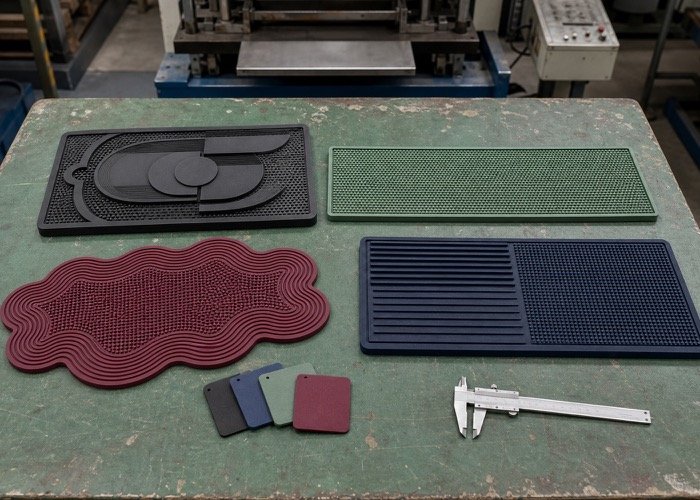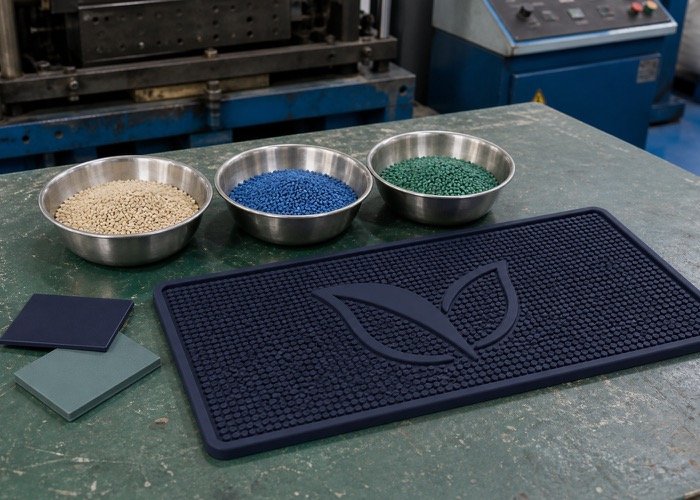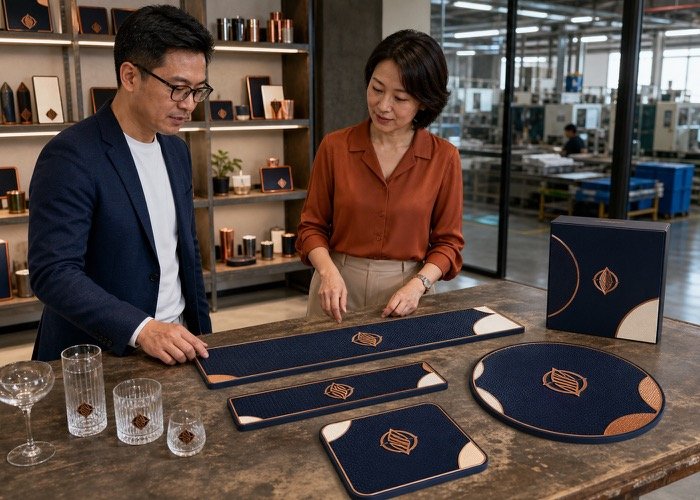

Захиалгат бар дэвсгэр сонгох гэж тэмцэж байгаа нь зөвхөн логогоо төгс болгохоос илүүтэй холбоотой. Хэмжээ, хэлбэр нь маш чухал юм, Гэсэн хэдий ч ихэнхдээ үл тоомсорлодог. Буруу тохируулга сонгох нь лангууны зайг дэмий үрэхэд хүргэдэг, эвгүй дүр төрх, эсвэл бүрэн алдсан брендийн боломж. This guide will help you determine the perfect bar mat size and shape for your specific application, whether you need a classic rectangle or a unique circle.
The best bar mat size and shape depend on its primary purpose. For high-volume, functional workspaces like service rails and prep stations, a long rectangular mat is superior. For branding, single-item displays, premium gift sets, or creating a unique focal point in a boutique setting, a round mat is the more impactful choice.
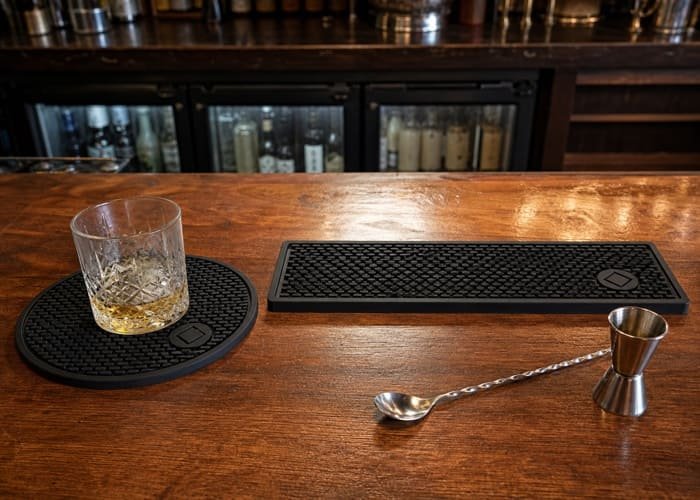
Одоо танд хурдан хариулт байна, let's dive deeper. The decision between round and rectangular goes beyond simple aesthetics; it impacts workflow, cost, and brand perception. Understanding the specific scenarios where each shape excels will ensure your investment in custom mats truly pays off.
When is a Rectangular Bar Mat Size the Best Choice?
Are you outfitting a busy commercial environment that demands efficiency? The rectangular mat is the industry standard for a reason, but simply defaulting to it without knowing why can be a missed opportunity. Choosing a different shape in the wrong setting could even hinder your team's workflow. Let's break down why this classic shape dominates high-traffic areas.
A rectangular bar mat is the ideal solution for high-volume settings like standard bars, coffee shops, and chain restaurants. Its linear shape fits perfectly along long, narrow countertops, maximizing the usable workspace for efficient drink preparation, service, and drying.
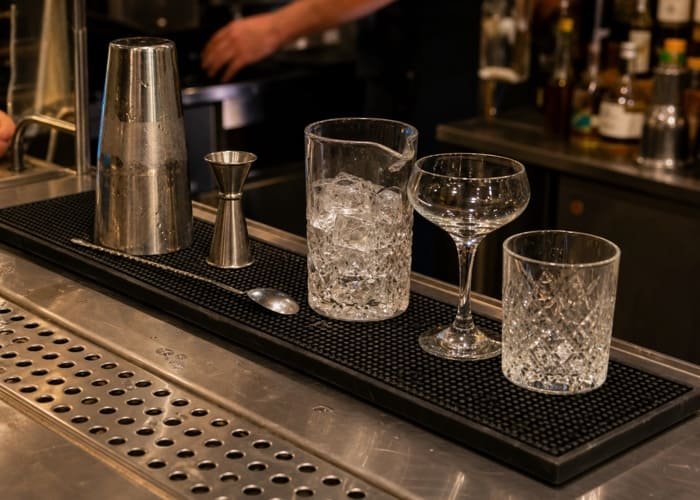
Гүн шумбах: The Case for Rectangles
Rectangular bar mats are the workhorses of the service industry. Their prevalence is a direct result of their unparalleled functionality in fast-paced environments.
H3: Maximizing Workspace and Workflow
The primary function of a bar is linear. Ingredients are on one side, the customer is on the other, and the bartender works in the space between. A rectangular bar mat size perfectly complements this workflow.
- Service Rails: Long, thin rectangular mats (often called "rail mats") run the length of the bar. They provide a non-slip, spill-catching surface where bartenders can line up drinks for servers to pick up. A common size is 24 inches long by 3.5 inches wide, but we can customize the length to fit your exact counter.
- Workstations: A larger rectangular mat defines a bartender's station. It's big enough to hold shakers, mixing glasses, jiggers, and strainers, containing messes and protecting glassware. This creates an organized and efficient zone of work. A mat that is too small forces a bartender to work off the mat, defeating its purpose.
H3: Cost-Effectiveness for Mass Distribution
When you need to supply hundreds of locations for a beverage brand promotion or a national chain rollout, economics are critical.
- Одоо байгаа хөгц: As a manufacturer, we at SuperfectCraft have a massive library of existing molds for popular rectangular bar mat dimensions. Using an existing mold significantly reduces your initial cost and speeds up the production timeline, as there's no need for new tooling.
- Material Efficiency: The rectangular shape is highly efficient to produce and cut from raw materials like PVC or rubber, which minimizes waste. This efficiency translates into a lower cost per unit, especially on large orders.
Here is a table of common rectangular bar mat sizes and their primary uses:
| Хэмжээ (Inches) | Common Name | Primary Use |
|---|---|---|
| 24" x 3.5" | Service Rail Mat | Lining up finished drinks for servers. |
| 12" x 18" | Station Mat | General bartender workstation for mixing. |
| 17" x 12" | Large Station Mat | Larger prep area, often used in craft cocktail bars. |
| 23.5" x 3.5" | Branded Rail Mat | Common size for beer and liquor brand promotions. |
For most commercial applications, durable and easy-to-clean PVC is the material of choice, offering excellent anti-slip properties and fantastic detail for embossed logos.
Why Choose a Round Bar Mat Size for Your Brand?
Do you want your promotional mat to be more than just a functional spill-catcher? A standard rectangular mat can sometimes get lost in the visual clutter of a busy bar. A round mat, however, breaks the mold and can serve as a statement piece that grabs customer attention and elevates your brand.
A round bar mat is perfect for creating a distinct focal point. It excels in boutique settings, on round bar tops, as a premium gift item, or for limited-edition marketing campaigns where visual impact and brand differentiation are the main objectives.
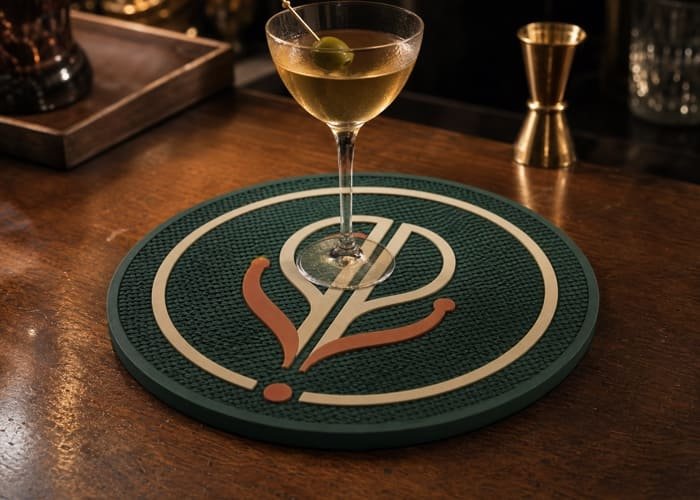
Гүн шумбах: The Impact of Circles
While rectangles are about function, circles are about focus. They draw the eye to the center, making them a powerful tool for branding and presentation. I once worked with a premium gin brand that was launching a new product. Instead of a standard rail mat, we designed a 10-inch round silicone mat. Bartenders used it to present their signature "gin and tonic" on. It became an instant photo opportunity for customers, and the "Instagrammable" moment generated huge organic marketing for them.
H3: Creating a "Wow" Factor for Branding
In a world saturated with marketing, being different is a massive advantage.
- Breaking the Pattern: Most bar counters are a sea of straight lines and right angles. A round mat instantly stands out, drawing the eye and making customers curious about the product or brand it's showcasing.
- Perceived Value: The unconventional shape feels more deliberate and designed. This gives it a higher perceived value, making it ideal for premium spirits, craft breweries, specialty coffee roasters, or high-end salons. It signals that your brand pays attention to detail.
H3: Ideal for Specific Use Cases
A round bar mat size isn't for every situation, but it's unbeatable in the right context.
- Point-of-Sale Displays: Use a small round mat to create a designated spot for a payment terminal. It looks clean, professional, and keeps the terminal from sliding.
- Single-Item Showcases: It's the perfect platform for featuring a "cocktail of the week," a new bottle of spirits, or a dessert special. It acts like a pedestal, telling the customer, "Look at this."
- Gift Sets and Merchandise: A round mat is a fantastic inclusion in a cocktail gift box or as a piece of limited-edition merchandise. It feels more like a collectible and less like a utility item.
Our 24-hour design sketch service is particularly helpful here. Visualizing how your logo fits within a circular border is key, and our designers can create a mockup to ensure the final product is perfectly balanced and impactful.
How Do You Determine the Exact Bar Mat Size and Dimensions?
You've chosen a shape that aligns with your goals—function or focus. But what about the specific measurements? Guessing the dimensions is a common mistake that can result in a mat that hangs awkwardly off the counter, is too small to be useful, or looks completely out of proportion.
To determine the exact bar mat size, you must first measure the available counter space where it will live. Дараа нь, consider the specific tools and glassware it needs to hold during use. Эцэст нь, factor in branding and visual balance to select final dimensions that are both functional and aesthetically pleasing.
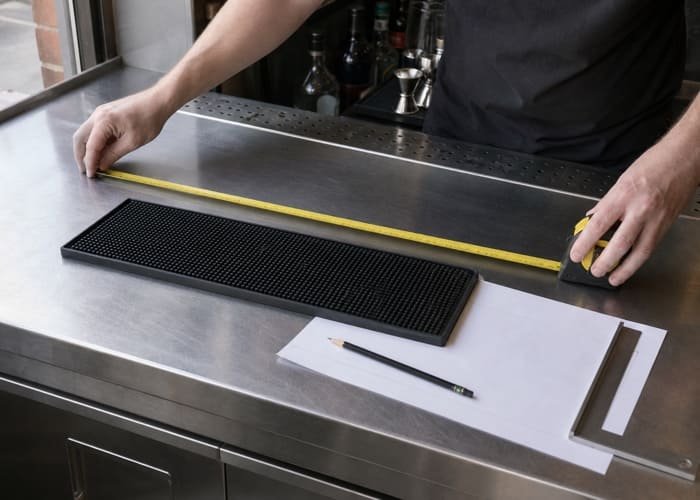
Гүн шумбах: A 3-Step Process for Perfect Sizing
Accuracy matters. A well-proportioned mat looks professional and integrates seamlessly into the environment. An ill-fitting one looks like an afterthought. Follow this process to get it right.
H3: Step 1: Measure Your Physical Space
Start with the basics. Use a tape measure to get the exact length and depth of the target surface.
- For a workstation: Measure the clear area where a bartender works.
- For a service rail: Measure the length of the bar edge where drinks will be placed.
- For a display: Measure the area where you want to create a focal point.
Pro Tip: Don't plan for the mat to cover the entire surface edge-to-edge. Leave at least a 1-inch (2-3 см) border of clear counter space around the mat. This "negative space" frames the mat, making it look more intentional and professional.
H3: Step 2: Conduct a "Dry Run"
This is the most critical step for functional mats. Gather all the items that will live on the mat during a typical shift.
- Place your shaker tins, mixing glass, jiggers, strainers, and spoons on the counter.
- Arrange them in a way that feels natural and efficient for your workflow.
- Одоо, measure the length and width of the footprint this arrangement creates.
This measurement gives you your functional minimum size. Your mat must be at least this big to be effective. Going slightly larger provides a comfortable buffer.
H3: Step 3: Balance Function with Brand Visibility
The final step is to merge your practical measurements with your branding goals.
- If your logo is wide, you may need to increase the mat's width to ensure it is legible and not cramped.
- If you have a complex, detailed logo, a larger mat size might be necessary to render it clearly, especially with our PVC molding process.
- For promotional mats, the logo's visibility is the top priority. It may be better to choose a slightly larger, more prominent bar mat size to ensure your brand gets noticed.
As an OEM/ODM partner, we are not limited by a catalog of "standard" хэмжээ. You provide the exact dimensions you need, and we produce it. We base production on your approved artwork and specifications, ensuring the final product matches your vision perfectly.
Байнга асуудаг асуултууд
What's the most common bar mat size?
For rectangular rail mats, 24" x 3.5" is a very common size used for brand promotions. For bartender workstations, sizes like 12" x 18" or 17" x 12" are popular because they provide ample space for tools without taking over the entire counter.
Can I get a custom shape other than round or rectangular?
Мэдээжийн хэрэг. As a dedicated OEM/ODM manufacturer, we can create custom molds for nearly any shape you can design. This involves a one-time tooling cost and is best for larger orders where a unique brand statement is the primary goal. Contact us to discuss the possibilities.
Which material is best for my bar mat size and shape?
PVC is the most popular choice. It's durable, affordable, and excellent for creating intricate, colorful 2D or 3D logos. Rubber is a heavier-duty option ideal for high-impact industrial settings. Silicone offers a premium, soft-touch feel and is heat-resistant[^1], making it perfect for high-end gift sets or coffee station mats.
Хамгийн бага захиалгын тоо хэд вэ (MOQ) захиалгат бар дэвсгэрт зориулсан?
Манай стандарт MOQ байна 200 загвар болон өнгө тус бүрээр нь ширхэг, especially when using one of our many existing molds. For fully custom shapes or sizes that require a new mold, the MOQ and pricing may vary. We confirm all details before starting production.
Дүгнэлт
Choosing between a round and rectangular mat is a strategic decision. The right bar mat size and shape are not just about catching spills; they are about enhancing workflow, strengthening brand identity, and making a lasting impression. Rectangular mats are the undisputed champions of function and efficiency, perfect for the fast-paced, linear world of a high-volume bar. Round mats, in contrast, are masters of focus and differentiation, ideal for creating memorable branding moments and elevating perceived value. By measuring your space, analyzing your functional needs, and considering your brand goals, you can select a mat that is a perfect fit in every sense of the word.
Ready to create a custom bar mat that is perfectly sized for your brand's needs? Whether you require 10,000 rectangular mats for a national rollout or 200 unique round mats for a special campaign, our team at SuperfectCraft is here to help. Contact us today at sales01@superfectcraft.com or on WhatsApp at +86 15816822766 for a free design sketch and a no-obligation quote.
[^1]: "Silicone rubber", https://en.wikipedia.org/wiki/Silicone_rubber. Reference materials describe silicone rubber as a soft, compliant elastomer with high thermal stability, typically remaining elastic up to approximately 200–250°C, supporting its use near hot beverages. Нотлох үүрэг: definition; эх сурвалжийн төрөл: нэвтэрхий толь бичиг. Дэмжиж байна: That silicone rubber is a compliant elastomer with high thermal stability in the ~200–250°C range.. Хамрах хүрээний тэмдэглэл: Exact properties vary by formulation; the notion of a 'premium' feel is subjective and not standardized.